Tuesday, March 8, 2016

Small, smaller, smallest – Syarra

Now we have been to five countries in Europe, on this trip.
  • France, which is 643,801 km squared.
  • Spain, which is 505,992 km squared.
  • Italy, that is 301,318 km squared.
  • Portugal, being 91,568 km squared.
  • Vatican City which is 0.44 km squared.
France which is not real small, is very small compared to the U.S.A, so that is the “small.”
Italy is almost half the size of France. That is the “smaller.”
And then you might know that the Vatican is the smallest country in the world! That is the “smallest.”
Like Carver's last blogpost, this must be distinctly understood or no good can come from this title.
Now we shall move back in time. To this morning.


Four people were taking a walk around 8:45. They crossed the street and soon were walking past a line that was so long it turned the corner of the vast Vatican wall beside them. They continued on past. They were now inside a metal gate herding them to the inside of a building. Once inside they walked towards a security booth and, with tickets, they passed through.

Continuing, they stopped once more at a booth, but this one was like the kind at a airport for security. They went straight to an escalator where they separated. One of them got on, the other three went up a long spiral ramp, in which models of boats were in separate showcases. When they all met at the top, they followed the sign towards “Sistine Chapel.” Oh, so much! It was as if all the statues in the world were either there on display or in a closet in that building. The mix of Greek, Roman, Egyptian, and Christian beliefs were displayed in many different ways.
Artifacts

Statues
Paintings
 With gold in every corner it makes you wonder how hard it was to build and paint this massive structure. Even the stairs were pretty.

Getting tired they reached “The Sistine Chapel.” Once inside this packed room they talked of stories and artists. Soon they followed the loop back and were outside quickly.


We had mixed feelings about this visit to the Vatican. It felt like they bought so many artifacts that they could not place them all on display. Though I enjoyed this visit in many ways there were some disappointing parts.

Granadilla is the same as Passion Fruit - Carver

Granadilla is the same as Passion Fruit. There is no doubt about it. They are as similar as Bird Meat and Poultry. This must be distinctly understood or no good can come of this blog post.

I'm sure you know where I got that from. At my grandparents’ house in Texas where they have lots of land, there is a garden. And there I tried passion fruit. It grows out of control and wasn't ripe when I tried it. But I liked it. It was small and green. And I figured that the small green fruit was what passion fruit looks like.

In Windhoek, I ate a granadilla. I ate many. They were big and purple. We were at the Hilton in Windhoek and they had many granadilla halves. And I loved them. I ate so many. And when everyone else was done, they asked if I wanted to stay there and eat more. But I figured I would get them later. So I went. At this time, I didn't know they were the same. They were called different things. And they looked completely different because the ones at the hotel were not unripe. At the store we got two but granadillas are very expensive. And they aren't even as big as an apple. They are probably a small orange in size. So, I was sad that I wouldn't get more granadilllas.

In either Morocco or Portugal, I began to figure it out. We went to a grocery store. And there were passion fruit flavored things. But it showed a picture of a granadilla. So now I am certain that they are the same.

Sunday, March 6, 2016

From Poop to Pope with Polylingual Puns – Erich

Today we made quite a transition. As you may know if you have been keeping up with the blog, we spent the last three weeks on a horse farm in Lot, France. We loved it. But our time drew to its end. So we had to say a sad goodbye to the twelve horses, two dogs, two cats, and eighteen chickens. (And you Scarecrow, I'll miss you most of all.)

We'll also miss our wonderful hosts. Yes, for two of those weeks we were on our own while they were on holiday. But they were so generous to us during the times we were together. They are an exceptional family and we are glad to have made such incredible new friends.

As just one more example of their generosity, today, we were driven over two hours to Toulouse so we could catch a plane to Rome. And let me say, if you want to get far removed from the rural life of a farm in a big hurry, just travel to a metropolis like Rome.

It reminds me of New York City in many ways. As we were descending to the Metro, I felt practically at home. It was like descending into the Times Square subway station, but a light version. They only have two metro lines (A and B, which makes a good deal more sense than the alphabet soup of New York. Actually, here's an idea! What if NYC replaced the letters and numbers that demarcate the various subway lines with emojis? Brilliant, right?)

And in true metropolitan fashion, I got super super overcharged for a meal here. Wow! I'm so not in Kansas (or more to the point, Lot) anymore, Toto.

But we are looking forward to exploring this amazing city come the morning. And maybe, dare to dream, it won't be raining. (We've been in Europe for over a month now, and it has rained all but about five days. I'm sure it hasn't rained over all of Europe that entire time. But it seems to do so wherever we are.)

As we were coming into the city proper by bus from the airport, Syarra noticed a restaurant called “Eat-aly.” Kind of clever, but it only works if you are an English speaker. So this is sort of a polylinguistic pun. To the Italians, (though many of them probably know enough English to get it), it's just a ridiculous name. To those from the UK or US, it's a pun. (It's not a very good one though.)

But we noticed a better pun in France. But this one only makes sense to English speakers in translations, and I wonder if it was intentional. I suspect not.

When you go from one departement to another in France, much like when you travel from one state to another in the U.S., you see a sign welcoming you to that new departement. Well, when you are entering Lot, the sign says “Tres Nature. Tres Patrimoine. Tres Lot.” Now “Tres” means “Much”. But if you translate it another way you get: A lot of nature. A lot of heritage. A lot of Lot.

I found that very funny. But I wonder if any of the French find it even remotely funny. Why should they? They aren't looking at it and thinking “What could this mean in another tongue?”

But maybe we will see more of that as we explore Rome with our Vati-can-do attitude. And if you didn't enjoy that pun, maybe this blog isn't the right Forum for me. (Yeah, that one wasn't funny. Sorry.)

Friday, March 4, 2016

UCH - Carver

Yes, the title of this post is UCH. But I assure you, it is not a misspelling of the word such or much. It is Ultimate Chicken Handler. Which I am. It started one day when I was bringing our chicken (Boneless, skinless, chicken breast I think. Certainly not a live chicken.) from the guest house to the main house. We generally cook in the main house. And I was carrying chicken bullion. And I do the chickens. So I decided I was the Ultimate Chicken Handler.

But I do the horses and I have a basic map of the place. Can you guess who drew it?

Pencil marks are ropes keeping the horses in. Pen marks are buildings. Two pencil dots are places where ropes can be opened. Two pen dots are doors. Broken line is a rope that get puts up at night and taken down in the morning.

And the chickens are loud and sometimes come outside our door to squawk at us. And this is why they are my favorite animal. Not just on this farm. (Don't get any ideas about whether or not I am loud.)

But anyway, the animals have been covered. The dogs’ other plans include going out in the evening. We let them out because they pee outside. But then one of them, Lincoln, never comes back in. So in the middle of the night, we wake up to Lincoln scratching at our door. Well, only my Dad has so far. As he has to go put them back inside.

Now what I have realized is that I have not yet done a Morocco Pop Quiz. And it should be smaller than the South Africa and Namibia one because we spent less time there. So there will be 7 Marrakech questions, a Fes question, and a Tangier question.

Marrakech

1. What is the other way to spell Marrakech?
2. What was the big grocery store we went to?
3. What part of the suburbs were we in? There are two acceptable answers.
4. What was the part inside the walls called(this is the easiest one)?
5. What was the main square with the orange juice sellers called?
6. What was printed on the train tracks we had to cross over if we walked(actually covered in the 100th blog post)?
7. Where did we fly in to

My one Fes question: What was the place we stayed at called?

My one Tangier question: What was the farther away port called?

Marrakech Answers

1. Marrakesh
2. Carrefour
3. Either Targa or Lala Hiya
4. Medina
5. Jemaa el Fnaa
6. The train company’s name(ONCF)
7. Casablanca

Fes Answer: Riad Mikou

The answer to my Tangier question will come in the next of my blog posts, Spain and Portugal Pop Quiz.

Yes, I am very behind on my pop quizzes.

I wrote this a while ago and never got to finishing the map. So, this is fairly old. I just gave away who made the map.

Now That's a Castle! – Erich

The other day we visited the Chateau de Castelnaud. This immense castle has been around in some form for 900 years or so. But different pieces of it were built at different times.
The Chateau de Castelnaud
Looking out from the ramparts, you can see why this was such a strategic position. You can see the river and valley below for miles.
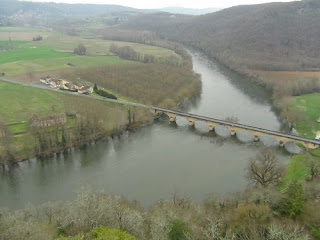
No sneaking up on this castle
In the Hundred Years War, the castle changed hands between the French and the English six times. Not all of those times involved battles. Sometimes a siege was enough (accompanied by a bribe, of course) to convince the current occupant to give up the castle for the other side.

But when a battle was involved, we saw a ton of the implements used in said battle. Because the Chateau de Castelnaud has huge displays of medieval weapons, siege weapons, armor, and implements of the time.

At heart, I suppose, I am still just a pre-teen boy who revels in the joy of looking at weapons and armor. For that boy inside, this was a treat.

For armor, the displays began with simple chain mail shirts or chain mail helms.
For the fashion conscious battle weary soldier
But you could see plate mail as well. Even a knight in plate mail on a horse covered in barding. (Barding is the name for the armor plates that a horse wears.)
Look ma! I'm shiny!
In the line of personal weaponry, well, you can always start with the classics: swords and daggers. We learned about the hilt and pommel, and how important the pommel is. It keeps your hand from slipping off the end, and it is there to counterbalance the weight of the blade.
It's kind of a double edged sword. Not just kind of.
But if something more exotic is your interest, what about flails, morning stars, or battle axes? How about all three?
I do not want to get hit by any of these!
Perhaps you are more of a war hammer type. Did you realize that these don't look anything like Thor's Mjolnir, but much more like really big versions of ball-peen hammers? I didn't.
Hey guys, after the battle, let's go drive some rivets
Have to face the cavalry? No problem. You just need a staff weapon or a pole arm. These allow you to keep your distance from the nasty charging knight while still dealing maximum damage.
I wouldn't touch that with a ten foot pole. Unless it had something sharp at the end.
Check out the many varied ends on these pole arms. They could be used for all sorts of things. And we learned that the inspiration for many of the shapes of the heads of the pole arms came from the agricultural implements used in those days.
From the fields of wheat to the fields of battle
And finally, what kind of defense could a castle put up without the trusty crossbow? Of course, the challenge with a crossbow is drawing back the string. In early forms, men just had to pull. But then they invented the stirrup crossbow. You put your foot in the stirrup and use the leverage of your whole body to pull it back. But when even that isn't fast and easy enough, here comes another improvement in crossbow technology: the crank! Not just for fishing anymore! You can use it to draw back your bowstring.
Ready, aim, wait, wait, pull back the string, then aim.
But personal weapons are only the beginning of a battle at a castle. What you really need are siege weapons and defense from those nasty crossbowmen on the castle walls shooting down at you.

Well, you could certainly use the monteau. This handy device lets you approach the castle with a huge wooden shield in front of you. And it has holes in it for you to shoot your own bows through.
A rolling wall. Genius!
But even better is to stay far away from the castle and blast them with varied catapults. Unfortunately for the besieger, the besiegee may also have defensive catapults on his walls. We saw a giant crossbow that was capable of launching a bolt which could go through three men, a horse, and still have enough thrust to lodge itself in a door. That's what it said! What a selling point. Because most people besieging castles bring along their own doors.

But the ultimate in siege weapon technology was the trebuchet. First, engineers invented the mangonel, much like the trebuchet. But the mangonel had a fixed counterweight. The trebuchet has a hinged counterweight. Why is that better? You still get all the launching power of the mangonel, but it is much easier (though still not easy) to lift the counterweight and reset the arm of the trebuchet for another shot. This brought the firing rate from about one per hour to two per hour. Huge improvement!
Knock, knock. Who's there?
The trebuchet was so effective in breaking open castle walls that it continued to be used for another 150 to 200 years after the cannon was invented.

Yes, after we learned so much about these weapons and armor, the kids were ready to sign up for the service! A new swordsman and knight in the making.
Brave knights

Thursday, March 3, 2016

Day Away - Syarra


Early one day there had been four people having a discussion. Then the discussion ceased, it had been about where to go, the decision was that we were going to explore the direction that had only briefly been touched. So we got into the hybrid, which is one of the two we were left with, and drove down the terribly small and windy road.

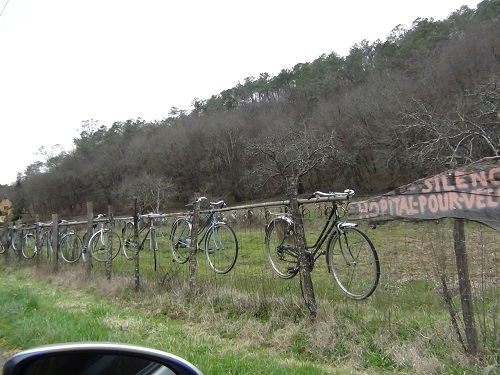
Driving we saw a yard for old bikes.
Sign says: Silence, Hospital for Old Bikes
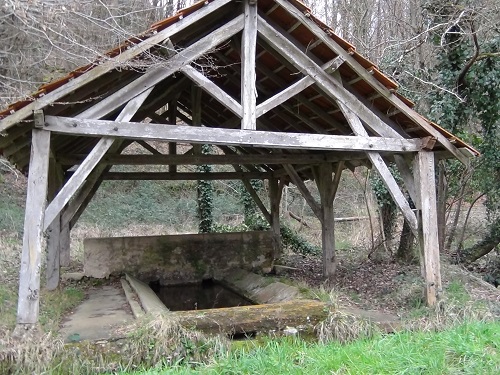
And a covered horse trough!
There is more than one of these
We saw amazing sights!
This is how they made the roof in medieval times
Soon thereafter I found out we were heading towards a castle. 
It was a castle that had a mini golf course. It had a swimming pool, and inside Josephine Baker had adopted children from around the world, and left them to grow up with servants. Unfortunately the
Château des Milandes was closed for the winter.
Les Milandes had a lot of work done on it

So we followed a loop towards home but stopped at Château de Castelnaud-la-Chapelle this amazing castle was used as a base in the 100 year war, including switching hands between the French and British. I think it was like 6 times! We had soon decided to come a different day so we could have more time to explore the castle. So we headed back and soon we were home.
This is the amazing base that was used so much in the Hundred Years War
That was great exploration!


Tuesday, March 1, 2016

Déjeuner – Erich

Today we enjoyed lunch at a restaurant. I know, that doesn't sound like much. Maybe it isn't. But this was a restaurant in a French town, and there were some similarities and some differences.

The restaurant was called Plaisirs des Sens, which means Pleasures of the Senses. It was in the town of Prayssac.

It was about 13h10 or 1:10 PM when we arrived. In France, lunch is from 12 to 14 (meaning 12 to 2). Businesses are open in the morning, close from 12 to 2, and then reopen until 6 or 7 in the evening. But the restaurants are open for lunch. And then they close and they open again around 7 for dinner. They are not the sort of come when you feel like it establishments that we are used to in the United States.

So we were on the late end of arriving for lunch. When we arrived, several tables were taken. We saw a table for four that was available, but we weren't certain if we were allowed to seat ourselves or if we had to wait for someone to seat us. Ultimately, the waiter came out from another room and we said we wanted a place for four by saying “Déjeuner. Quatre.” Quality French there. I said “Lunch. Four.” He pointed to the open table set for four and we sat down.

The entire time we were there, only this one man ever came out to interact with customers.

Next came the dilemma of menus. He didn't give us any. He didn't seem keen to give us any. Eventually, Alrica walked up to the bar, took two menus, and brought them back to our table. We hope we didn't make a faux pas in that. (More quality French.) Later, one other couple came in. They seated themselves and went up to the bar, looked at the menus there and then sat down again.

The pricing structure for the menu was a bit different. Like in the U.S. there were appetizers (which they call entrées, so I'm not sure how entrée in English came to mean the main dish. It makes more sense as an appetizer, because it basically means entry.) Like in the U.S. there were main dishes (which they call plats.) And there were desserts (which they call desserts).

You could order these a la carte. (Wow! Quality French everywhere.) And all entrées would cost the same price, regardless of which entrée you ordered. All plats would cost the same price, regardless of which plat you ordered. And all desserts would cost the same price regardless of which dessert you ordered.

But it was a better deal to get the menu. Not the paper on which the items were listed. But the menu meant you were getting a combination of these courses. So you could order a plat and a dessert menu. This meant you chose any one plat and any one dessert. And then there was a fixed price for that, regardless of which plat or which dessert you chose. And that fixed price was less than the sum of the a la carte price of the plat and the dessert.

There was also a menu that allowed you to order an entrée and a dessert for one fixed price (less than the price of the menu of plat and dessert.) Or you could order an entrée, a plat, and a dessert as a menu. This, of course, cost more than the menu of plat and dessert. You could also order a menu of an entrée and a plat. Okay, you get the idea. You could get menus that combined, in various ways, these three choices (and actually some of the menus had a fromage or cheese as a course you could choose too, but I didn't want to confuse you.)

We each got a plat and a dessert. I had magret de canard, which is duck breast. I often think of duck as being greasy, but this was not at all greasy. I enjoyed it.

For dessert, I got a tiramisu, but not a traditional tiramisu like you might have gotten before. This one had a similar top layer, but then the lower layers were liquid and delicious. The flavor was much like the traditional tiramisu I have tried before.

Alrica had a filet Julianne, which was fish, and then a flan for dessert. And the kids both had piece de bœuf, which was literally a piece of beef (steak). And they had fruit salad with a scoop of ice cream (un boule de glace) for dessert. Carver chose passion fruit ice cream which in French is fruit passion. Syarra chose menthe au chocolate or mint chocolate.

We were asked, “Cafe ou fin?”. “Coffee or finished?” We said, “Fin.” But even then, the waiter did not bring the bill. This seems to be a common theme in restaurants outside of the United States, or at least in the nations we have so far visited. I guess you have to ask for it. I went up to the bar and then he presented it to me and I paid. (No dine and dash here. We are totally above board.)

So there were many differences. But one thing was the same. Music. They played music in the overhead speakers as we ate. Nothing too loud. Nothing too distracting. But when we paid attention, we realized it was songs in English that we would hear on the radio in the United States. Love lifted us up where we belonged. And someone paved paradise and put up a parking lot.

It was a lot of fun, an interesting cultural experience. And a tasty one.