Showing posts with label India. Show all posts

Monday, February 6, 2017

Agra Culture - Erich

Are any of you Batman fans? If so, you certainly know that the Joker is not the Crown Prince of Crime, but rather the Clown Prince of Crime. Of course his throne is, as often as not, in Arkham Asylum. At least after Batman wins. That never seems to last long though, which is probably good for the Batman franchises.

No, we did not see the Joker while in India. Nor did we see Batman. But let me tell you what we did see.

We ended our time in India with a quick jaunt through Agra and then a day to relax in New Delhi. We were flying out of New Delhi toward Kathmandu, Nepal. But we went to Agra to see its most famous (and possibly India's most famous) site: the Taj Mahal.

Much as the Joker is the Clown Prince of Crime, the Taj Mahal is the Crown of Palaces. (Not the Clown of Palaces. Try not to get confused.) However, much like the Joker, it is a most appropriate name. The Taj Mahal is glorious.
See? Glorious! Even with the scaffolding.
You've probably seen many pictures of the Taj Mahal. Some places in the world, when you see them in real life you basically don't see much more than in the picture. But not so with the Taj Mahal. The pictures do not capture the details, the craftsmanship, or even the full big picture.

The Taj Mahal was built to be a mausoleum for a queen. The king, Shah Jahan, loved his fourth wife, Mumtaz Mahal, intensely. He also loved architecture. When she died delivering their fourteenth child, he merged those two loves and began work on building a magnificent resting place for her. The gigantic white building with the curved domes and long slender minarets, the one you always see in pictures, that is the mausoleum. But that is just one of the buildings that makes up the Taj Mahal.

You arrive first at one of the outer gates to the Taj Mahal. These are in red stone, and there are three: the West Gate, the South Gate, and the East Gate. (To the north of the Taj Mahal is a river, so no gate that direction.) Here you pass through security. These outer gates are nice enough, but probably would not make Agra a tourist capital without what was within. (Did you like that use of without and within in the same sentence? I think the Joker would approve.)

Within those gates is a rectangular courtyard, longer to the east and west and shorter north and south. There are walls on all sides with gates of course in the center of each. And the gate to the north is the Main Gate.
View from without, within.
The Main Gate is a tall red gate with many white details about it. It has cupola towers on its corners and a series of small cupola roofs across its top. It's actually a double gate. You walk through the first gate and then you have to walk another 15 meters or so to get through to the second gate and out into the Taj Mahal courtyard.

But even before you step into the Main Gate's first gate, you can see the Taj Mahal through the large opening. It's quite a sight, framed by the pointed arch.
There it is in the distance.
Still, walking through the second gate takes you into a much larger garden courtyard. There are paved paths leading to the famous Taj Mahal building, but grasses, bushes, and trees as well. There are also reflecting pools to really frame the moment. In addition to the flora, we saw bright green birds, kite birds with incredibly long tails, and some sort of bird of prey circling. And there were monkeys running along the walls the enclose this large courtyard.

The Taj Mahal's famous building, the mausoleum, is not alone. It is higher than the courtyard on a raised terrace. But on each side of it is a building. On the east side is an assembly building and on the west is a mosque. Each is large and intricately decorated. In fact, they are mirror images of each other on the outside. Bilateral symmetry is the overarching design idea of the Taj Mahal (with one exception that I will get to later.)
You can see the mosque (left) and assembly (right) peeking above trees.
The two side buildings aren't identical on the inside, but they are almost identical. The inside of the assembly building is basically an open space. In the mosque, there is a structure to indicate which direction the Kaaba in Mecca is, as well as a raised platform from which services can be led and calls to prayer can be made.
This is the mosque. If you want to see the assembly, just look at this picture through a mirror.
Each of the side buildings is made of the same reddish stone, but capped with graceful white domes. The domes themselves have metal spires atop them. It's funny (though not funny in the way the Joker would appreciate), but if these buildings were on their own, they would probably be architectural masterpieces shown in pictures. But since they are merely the sidekicks of the central mausoleum, they just don't get that kind of attention. I suppose this is comparable to Robin and Batgirl, who, while yes everyone knows them, they don't get nearly the play that Batman does. And without him, who would have ever heard of them?

Let's talk about the mausoleum, the famous building most people think of as the Taj Mahal. It is grand even from afar. But as you get closer, you see the incredible amounts of marble, the details in the engraving, and the unbelievable inlays. All along the outside of the Taj Mahal mausoleum, there are places where shapes were carved out of the marble to be filled in with semi-precious stones. But these stones were chosen and shaped so that they make vines and flowers and leaves.
I don't know what stones these are, but each is beautiful.
Some of inlays surround equally impressive reliefs carved from the marble.
Look at those carved flowers!
Other inlays are in geometric patterns that pull your eye into them.
Your eye is so pulled into this rectangle, you don't even see this caption.
It's also difficult to believe that the dome can be that big, that high, and keep standing. (Don't worry, it does.) The mausoleum is framed by four tall minarets that stand slightly shorter than the dome. In addition, the mausoleum building was designed with exactitude in proportions. Its width (from minaret to minaret) is identical to its height. It makes for a very pleasing to the eye image.
The way into the mausoleum
Visitors are allowed into the mausoleum, though they have to either remove or cover their shoes to do so. The inside is much darker, as there are no electric lights. While some sunlight does enter, the ceiling is a solid dome, so it's pretty dim in there. Luckily, you are allowed to use flashlights. That's lucky because you would not want to miss the art of that interior. Unluckily, you are not allowed to take photographs of the inside of the mausoleum. But I guess that just forces people to go visit it to see the real magic.
The east face of the mausoleum
Remember how I talked about the inlays on the outside? Well, they are nothing compared to the inside. As an example, outside a red stone might be cut into a flower. On the inside, several red stones were carved into the individual petals of the flower. And these stones are more precious gems.

Every centimeter of the central room is carved or filled with inlay or inscriptions. This is the room where the tomb of the beloved wife is. It's also where the king himself was buried when he died many years after she did. And that leads us to our one deviation from bilateral symmetry.

When the queen Mumtaz Mahal died, her tomb was placed along the axis of symmetry, centered in the room. It is a rectangular tomb made of marble with carving across every surface. It's beautiful. It lays with its length north and south and its width east and west.

But then when Shah Jahan died, where could they put his tomb? The only way they could have kept the symmetry was to build his on top of hers. But that isn't what happened. Instead, the king's tomb, even more impressive than the original, is placed just to the west of the queen's tomb. So the king, like the Joker, is off-center.

Except Shah Jahan isn't a super-villain. Or if he once was, Batman wasn't his nemesis.

Thursday, February 2, 2017

Stares and Stairs - Syarra

In India more so than anywhere else, we have found that people stare at us. That includes the many, many, people in the City of Jaipur, in the State of Rajasthan. It seems as if they have never seen white, or western, people. Which surprised me because in a city, like here, with two point three million people I find it hard to believe that they have never seen someone with white skin. For one thing I have seen white tourists, and I have been here less time then the people who live here so I find that hard to understand. That concludes the part about stares.

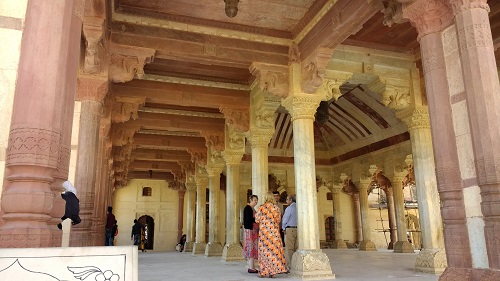
Now for stairs! And hallways. A few days ago we went to the Amber Palace or Amer Fort. The Amber Palace was at one time the capital building for the Kachwaha Empire. It is located on top of a hill looking over the Town of Amer. The palace was built by Raja Man Singh the First. He was the leader of the empire at the time. It has been extended since. We were brought by a tour guide in a car. But he did not come in with us.
View from the car.
 We sort of did without a guide. But that is a later story. We entered the area of the palace, in front of us we saw a path which ended in stairs scaling the hill. At the end of it you got tickets. We did and then continued stopping only to enjoy the amazing view.
 
An obelisk below
Climbing and seeing the Amber Palace


And Climbing and seeing another view

Arriving in a courtyard

In the courtyard

 This fort, or palace, has many hallways, and staircases that lead into darkness, which makes it an easy place to get lost. There were a few thing that made our experience fun to look back on. These are the ceaseless entertainment and freedom of the exploration, the, sort of, guide, and the sight of the “Great Wall of Amer” (as I call it).
The Ceaseless Entertainment and Freedom of the Exploration.
The Amber palace had many interesting rooms. Such as the mirror palace where inlayed in the wall was reflective pieces of glass. I enjoyed the ability to go anywhere. If we were in the U.S.A. there would be ropes blocking off anything at all dangerous. In most staircases here there were no handrails and the steps were uneven.
In an alcove

The King's prayer room

The Mirror Palace

The audience hall
The, Sort of, Guide.
At one point when we were exploring there was a sign pointing down a hallway that said latrines. We were interested so we walked that way. A man, dressed in a uniform which we assumed was of the guards, came and offered to guide but us we assumed it was just to the latrines so we could find them. Then he continued to show us things. He explained that the king had sixteen wives and 150 girlfriends! Though after he showed us something he waited for us. Not wanting to be hurried, we decided to go on our own. But we felt we must tip him for his service. But not knowing the system for tipping, we did it clearly wrong which we frequently do in India. We gave him 30 rupees and then he gave us a dollar and asked for a rupee. After a while we deciphered that he wanted to exchange a dollar for rupees instead. But of course that was not what we wanted so we turned down the offer.
The Sight of the “Great Wall of Amer” (As I Call It).
If you have ever seen pictures of The Great Wall of China, picture that far away. This wall had two layers, a higher one with murder holes, and a lower one that was wide so if needed whole army could march to the Jaigarh Fort which you can read about below.

The Purple arrow is the Jaigarh Fort. Red is The Great Wall of Amer

Another View of the Great Wall of Amer

Purple is the Great Wall of Amer. Blue is a king's garden

Red is the Jaigarh Fort. Purple is the Great Wall of Amer

The Jaigarh Fort is on a taller hill and in a more defensive position were the castle attacked. There is a path that is half under ground and the other half under the protection of tall walls, that conects the Amber Palace and Jaigarh Fort. We walked up the path as far as it extends today, and than walk a paved path the rest of the way. Though due to the fact that we were tired we did not enter Jaigarh Fort and instead turned back.
Carver and I looking down on the outer Wall or the Jaigarh Fort

While India has its downsides as you can see in:
What Confused the Skittles and in India is Hard
But there are good things too.

Friday, January 27, 2017

What Confused? the Skittles - Carver

India.

We arrived in Kochi late at night after a flight. We wanted a SIM Card but we were told that we would have to wait a day. But SIM Cards most times don't work when we first get them. And we didn't want to have to go back to the airport to fix it (because less so than in KL, but still comparable, the airport is ridiculously far out of the city.) Also only Vodafone SIM Cards only work in all of India. Other ones only work in that state. So we had to get a Vodafone SIM Card. But in Fort Kochi, the main part of the old city, we couldn't get one because they all wanted a sponsor. We finally found one near the docks. But they said it would take a day. It turns out someone in the government has to check everyone. So that Confused? us. Also, someone didn't do their job in time because when it didn't work like it was supposed to and we went back, he said it would take another day.

The first night was Confusing? as well. We arrived with no SIM Card because we didn't want to get one at the airport. We were staying in a hotel. But when we arrived, we couldn't find it. We saw a big sign for it but we couldn't figure out how to get in. Our taxi driver we took from the airport was very nice. He helped us find it. Even when we found the entrance, no one was there. After the taxi driver made many calls, someone came down and checked us in. On the main floor, there was a dead roach. Admittedly, the lobby was open and had no door to the outside but our room also had one. Fortunately, we never had a problem with live roaches while we were there. That morning, we took an Uber to Fort Kochi because we didn't have cash we could spend (the ATM in the airport only gave 2000 Rupee (or Rs as you see written here) notes. That morning, we also found a bank that would give us small bills for our 2000s. Fort Kochi was where we had to pay cash upfront for the entire stay. But we did.

One day I am going to write a blog post about public transportation but first let me say a little bit about the public transport in India. Kochi has around 600,000 people and not even a single train line. It is building one (but has gone past a deadline and then past a new deadline.) Jaipur has 2.3 million people and only one Metro Line (again, they are building another but they haven't finished.) Fortunately, Delhi has 5 Metro Lines, a Loop Line, and an Airport Express Rail.

So Kochi only has buses and ferries. The ferries are easy but the buses are much more Confusing?. There is not a map of the bus routes and most of them have their final destinations written in Malayalam only (which is completely different from Malay, the language of Malaysia.)

Kumily was probably the easiest of everywhere. The Internet didn't reach the third floor and we had SIM Card problems. We were having problems with the SIM Card when we left Kochi but it was too late to deal with it there so we called Vodafone Help and we put on an exact amount of money that they told us to. Then it worked. That was another Confusing? thing. Probably, the person who sold it to us didn't pay some fee and so we had get exactly that to pay the fee. When we had tried with other amounts of money, it said it couldn't process.

We returned to Kochi and flew to Mumbai. Mumbai wasn't very hard either (except for the crazy Uber driver) but we were only there for one day.

Here in Jaipur we are having a hard time as well. We can't find grocery stores and we need them now (in Kumily we got breakfast and dinner and in Kochi, there is always stuff all around because we were in the main part of the city. We also weren't tired of always eating Indian food yet.) There are no malls and nothing feels American. The roads are loud from honking (or sounding your horn, as they would say.) On the back of many vehicles, it says "Sound Horn". This means to honk if passing (or overtaking, as they would say.) There are rarely sidewalks. One day we found a store called the Country Store full of imported products. So many American things were there. They were also horrible prices but I saw American things including Veggie Straws (my first time seeing them since the U.S.) and Pop-Tarts (also my first sight of them since we left.) They also had a good selection of cold cereal but we don't have bowls, spoons, or a refrigerator to store milk in. They also had Confused? Skittles. On the bag was written "Confused?" and then down lower on the bag "Skittles". They are apparently Skittles with colors that don't match the flavors. And the Skittles are Confused? because they are in India and India is Confusing?.

Thursday, January 26, 2017

India is hard - Alrica


We have been traveling for a year and a half now through 21 different countries. Each country has its own language, culture, food, and natural landscapes. We love learning about the differences and fall back on the similarities to ground ourselves. We have gotten good at finding our way around, knowing what to expect, and settling in to a new culture. It isn’t working in India, either north or south India. India is the first place that is different to us in an uncomfortable way. Everything here is hard.

Visa: India’s visa questions include who your parents are, where they were born, and what their occupation is. Almost as if they don’t want you there to begin with. Americans can get a thirty day visa. We were arriving on Jan. 7 and leaving on Feb. 6, which should be thirty days. Except that isn’t the way they count it. We had to change our flight to Feb. 5. No exceptions and severe fines if you leave late.

Security: Showing a passport is standard at most hotels throughout the world. They have to know who you are after all. India requires all of our passports at each hotel. They also scan our luggage and backpacks everywhere. Granted, there are always separate lines for men and women, but I have been patted down and wanded 7 times in the past two weeks.

Money: In November, India decided to shake up its monetary situation. In a purely cash economy, people weren’t reporting their income so the government eliminated 500 and 1000 rupee notes, forcing everyone to turn them in to banks to get valid ones. Since they hadn’t notified the banks ahead, there was not enough cash to go around so they limited withdrawals to 2000 rupees each day (and now have raised it to 4500 rupees each day). That assumes you can make a withdrawal. When the ATM runs out of money, you are out of luck. One afternoon, we tried eight machines before we found one that was stocked. And if the machine only gives 2000 rupee notes, good luck getting anyone to take it. Daily visits to the ATM are part of life here, but for us, the challenge was getting ahead of our cash needs without getting stuck with rupees at the end. The two bedroom hotel for 12 days cost 30,000 rupees ($441) which they wanted up front in cash. However, a meal is easily only 400 rupees ($6) for all of us. Money converters around the world have stopped exchanging rupees.

Cell Service: We travel with unlocked cell phones and buy local prepaid sim cards when we arrive in each country. In most countries we pay around $4 for a month of cell service and data. India is similar, except, when you first purchase your sim card, there is a 1 day wait period while the government checks you out. This ended up being a 2 day wait followed by another five days of not having service that worked correctly and multiple calls and visits to Vodafone. A week without google maps in a new country is harsh.

Transportation: Our favorite way to get around in many countries has failed us here in India. Uber is pushing hard to develop a presence here with signs in most transportation hubs but they aren’t vetting their drivers so we have had some pretty bad experiences. Then there are the trains. India has the most extensive train system in the world, but, as a foreigner, to buy tickets requires government approval. I started trying to get approval nearly a month before we arrived. I filled out the form and sent in the required email. And then followed up. And then placed a phone call. Followed by 3 more emails. I still don’t have approval. This means that we won’t be taking a train here. Hopefully the buses are comfortable.

Language: So if we don’t use uber, surely one can just get a taxi. Well, yes, except language is an issue. India is an amalgamation of 29 states and 7 territories, all with their own original language. Their historical occupations left them with English as the only common language so everyone speaks English with a very heavy accent from their native tongue. We try to speak slowly to them but the favor isn’t usually returned and I find myself able to understand one out of every three words in most places. Even their body language is different with our standard nod to mean yes replaced by a figure eight wobble of the head. Google translate doesn’t handle accents.

Power/internet: We tend to be heavy internet users and book hotels based on how strong the internet it. In Kerala, it was pretty good as long as we went down to the second floor. Wifi didn’t really reach our rooms on the third floor. In Kochi they shut if off at night. Here in Jaipur, the internet is decent as long as we have power. Even our first couple nights here in a Hilton lost power intermittently.

Filth: There seems to be no garbage removal system in India. The custom is to just throw your trash wherever you are. It is in the streets, sidewalks, and “greenspaces.” Piles of trash and rotten food build up everywhere. And then there is the public urination. For men, the custom is to pull to the side of the road, get out of your car, and pee on a wall. In some places, the urine is so strong that it burns your eyes as you walk past it. They do have “public conveniences” which seem to be open all the time. And then there are the open trench urinals which are basically holes in the ground meant to pee into (or you occasionally see someone sitting to poop). You can smell these several blocks away. For a country that places such a high emphasis on women’s modesty, it is amazing how comfortable men are with doing their business in public.

Animals: Stray cats and dogs are common in a lot of places around the world, but India raises it to a new level. Goats, pigs, cows, monkeys, and chickens wander through the city streets grazing on whatever they can find. Remember those piles of trash? We are told that they go home on their own at night. Elephants and camels aren’t unusual sights either but they, at least, usually have handlers with them.

Shopping: Grocery stores have their own character throughout the world but everywhere has them. Except India. Purchasing food means buying from the guy with the street cart, visiting several market, or answering the shout of someone walking down the street with a bag full of onions. Very few western packaged choices (though we did finally find a small store aimed at expats). Speaking of western choices, we don’t frequent American fast food chains as we travel, preferring to eat locally, but India is the first place that we just aren’t seeing them. I mean never. I had hoped to visit a McDonalds to see how they handle the vegetarian preferences of the locals but haven’t found one yet.

This is just a short list of all the ways India stands out to us, and why we just can’t seem to get comfortable. We work hard as we travel to blend in. We love eating street food and following the locals to enjoy the customs that they enjoy. We try to respect the differences and not judge a country based on our own upbringing, but India is hard. For the next week, we will continue to eat spicy food with our hands, ignore the people that stare at our pale skin or watch us eat, and continue to hope that Indians will work harder to take care of their world but I don’t think any of us will be sad to leave India.

Monday, January 23, 2017

Global Positioning Superfluity – Erich

Call me chicken if you must.

We had to fly from Kochi in the Indian state of Kerala (in the south) to Jaipur in the Indian state of Rajasthan (in the north). But our flight had an overnight layover in Mumbai. We arrived into Mumbai at around 10 at night and flew out the next morning just before noon.

Having no desire to spend the night in the airport, Alrica found us a hostel in which we could stay the night. It turns out it was close enough to walk between the airport and the hostel and we actually did walk back to the airport on the following morning. But, being nighttime, we did not choose to walk to the hostel. Instead we used an Uber.

Uber has been a huge help on this trip. In many places it is very efficient. You pay through the app by credit card so you don't have to have the proper cash or the right size of bills. Plus, the drivers can't cheat you by purposely taking the long way around and running up the meter, because Uber gives you an estimate of what your fare will be. Great, right?

Usually, yes. But like so many things in India, this was harder than it needed to be.

First we requested the Uber. Now, it is pinned to your phone, so the app knows where you are. But we were in the airport and there is a specific place for the driver to meet you there. We went there. Our driver did not. At least not at first. You can watch where your driver is on the app, and he must have circled the airport roads at least half a dozen times. He was apparently unable to find where he was supposed to be.

But he did eventually (probably after 20 or more minutes) find the right place. And we would have been better off if he hadn't.

This guy was young. Not only did he look young, he drove like he had just gotten his driver's license yesterday. He met us in the airport parking garage. Just trying to get out the garage, he was clueless. He couldn't follow the signs that said "Exit" and had arrows pointing the way. He would miss every single turn. He would always go too far, then have to put the car in reverse, back up, and make the turn.

You know how some cars can "turn on a dime." This car couldn't turn on a merry-go-round. I'm not saying the turns he was making had a radius as wide as the Large Hadron Collider, but had we be subatomic in size, CERN might have been watching us to determine if we were Higgs-Bosons.

But it wasn't just missing his turns. He would manage to stall the engine every time he had to switch gears into or out of reverse. Then, in our last big turn of the parking garage, he again missed it. This time, when he backed up to make it, he hit the car behind him. Twice. Yes, he hit the car the first time. Now all the men in the parking garage are yelling at him. This flusters him, so his solution is to roll up his window so he won't have to hear them as loudly. Then he fails to make the turn again, and backing up the second time, hits the same car again.

The experience in the parking garage should have prepared me for what was to come. Because missing turns was kind of this guy's thing. His GPS is telling him "turn left in 100 meters." Maybe 300 meters later, he's trying to figure out where he is supposed to turn.

So we are in the vicinity of the place, and he has missed his turn, made a U-turn, gone back, and missed the turn again. So he stops sort of halfway in a lane of traffic and halfway out of a lane of traffic. This may seem crazy, but actually that's more or less standard India driving practice. This was probably the best maneuver he had executed during the entire ride.

So I tell him that he missed his turn, it's behind him. He needs to make the U-turn again and try it once more. But he decides he doesn't want to make the U-turn again. He wants to get this over with. So he puts the car in reverse and drives backwards in one lane of traffic to get back to his missed turn.

What exactly does he want to get over with? Our lives? Because even at 11 at night, this is a pretty busy road. And he is going the wrong way!

In case you were worried, we lived. We didn't even hit any cars, though I give most of the credit to the cars veering around us, and not to our Uber driver.

Now we are on a tiny narrow street where there is basically only one way to go, and even then he missed his turn. I guess he figured he could keep going through the building that was straight ahead of us. (No he didn't hit the building, but he did have to back up again. And stalled his engine again. Twice.)

I'll admit walking to the airport on busy roads that don't really have proper sidewalks is a bit risky. And we did have to cross an incredibly busy street. But it had a walk signal. But the walk signal only lasted five seconds. By the way, that's not an exaggeration. The walk signal has a countdown timer, and it begins at five. Even with all of that, we were far safer on the walk back to the airport than we had been on the way from it.

Someday I might like to return to Mumbai, to actually get to see more of it and spend a slightly longer time there. But if I do, it won't be so I can again enjoy the risk-your-life thrills of an Indian form of the game of chicken. And I think you would feel the same.

Chicken!

Thursday, January 19, 2017

Where's the Beef? – Erich

We have been in India now for about two weeks. And it has been different, surprising, unexpected in many ways, mostly good. Not all good.

My post today will about the new kinds of foods we are trying. But I did want to mention one other difference as a way of an apology. Internet access has not been all we might have dreamed. So I am just getting to posting in the blog now, because I haven't had strong enough access before this.

Now, on to food! We have gotten to try so many new foods, variations on foods we know, and live-in India authentic version of Indian foods we thought we knew.

We started in Kerala, which is one of the states. Kerala (pronounced like the name Carol and then uh at the end) is in the southwest of India, bordering the Arabian Sea. The first several days we were in the Kochi area. Next, we were in Kumily.

We are told Kerala is unique among Indian states in that it is the only one in which beef is sold and eaten without any sort of taboo. In Hinduism, cows are sacred and therefore not eaten (or if eaten, it is a guilty pleasure.) But for some historic reason that prohibition was never in place in Kerala.

I've seen different stories as to why. Some stories say that Kerala was unique in having Hindus, Christians, and Muslims who basically all got along pretty well. In fact, one group of Christians in Kerala extends back earlier than there were Christians in Europe. According to legend, St. Thomas, one of the original disciples, came to Kerala soon after the crucifixion and began proselytizing. Regardless, recipes passed back and forth through kitchens of Christians, Hindus, and eventually Muslims, and everyone got used to eating the same things.

Another story says it had to do with water. Kerala is very wet and grows many trees. These block the sun from reaching garden vegetables. And therefore, they had to eat cow as a matter of necessity. Now, I recognize that there is a missing step in that argument. Few vegetables means more cow, less mutton? If you don't get it, you're in good company.

The point is, you can eat beef. But not everything I want to talk about has beef in it. In fact, most things don't.

Let's break it down and start with breakfast. Our first morning, we ate dosa masala. Dosa is sort of pancake, but with a slightly sour flavor. Inside a dosa masala is a paste made of potato and curry. There were even chunks of potato. We have also enjoyed dosa with a dal curry on top. (Dal is a type of lentil. I'll mention dal again! I like it.)

One morning Alrica tried porridge, which was much like oatmeal. We've enjoyed appam. Appam is also thin like a pancake, but made of a fermented rice flour. It is purely white in color. Some appam have an almost sourdough flavor. Others are not as strong in their fermented flavor. It can be topped with fruit and sugar or with a curry. (Curries for breakfast seem very popular.)
This is appam (like a snow white pancake cloud)
The kids favorite was idli. Idli is sort of a rice vermicelli that has been shaped into patties. Of course, you can eat it with a curry on top. But you can also eat it with mashed up banana and cream and sugar. That's the way the kids loved it.

Another Indian breakfast we tried is putu. Putu is made of a fine rice powder cooked in some container so the end product has a shape. The traditional putu container was a bamboo section, so putu often has a cylindrical shape. But we also had it where it had been cooked inside a coconut shell, and so was more of an egg shape. You won't be surprised to find out you cover it with a curry, will you?

Let's get to other meals. Much of southern India specializes in vegetarian cuisine, but there are plenty of meat alternatives too.

I mentioned that in Kerala one can eat beef. In fact, Kerala is known for a dish called the Kerala beef fry. It is strips of beef cooked in a spicy sauce served with some peppers. I enjoyed it.

We had pizza with Tandoor chicken (cooked in a tandoor oven) and paneer on it. Paneer is harder to explain. It is small cubes of a soft dairy substance sort of halfway between cottage cheese and cheese curd. (If you don't know what cheese curd is, I realize that this description doesn't help you. Let's just say paneer has a bit more solid a texture than cottage cheese, and the curds are bigger.)

Another delicious meal is aloo gobi which literally means potato cauliflower. And that's what the main ingredients are, potato and cauliflower. But it is in a delicious sauce. Some places make the sauce a bit spicy, others do not.

I particularly enjoy dal, those lentils I mentioned. I have tried a couple of varieties: dal tadka and dal fry. Dal tadka is made with ghee which is more or less like lard. Dal fry is much spicier and in a darker sauce.
A banana leaf plate. Also, the yellowish dish on the side is made of papaya.
One night we ate rice and curry off of banana leaves, no plates. In India, the traditional way to eat is with your hands, not with forks and knives. Of course, forks and knives are often (but not always) available for Westerners. Anyway, you scoop your curry and rice up with your right hand. Never use your left! Left hands are unclean. (Sorry left-handed people, this is not my rule, just reporting it as I am understanding it.) You can also use your thin bread to scoop it up. That thin bread might be chapati which is made in a frying pan and looks like a pita, though has a different flavor. Or it might be paratha which is fluffier and airier. Or it could be nan, which is even airier and is made in a tandoor oven. When you are all done, you go and wash your hands. Every restaurant has a sink available (even those that don't have toilets available) for a postprandial hand-wash.
Happy banana leaf eating family (and another family)
What about fruits? Did you know that in Kerala they grow fourteen different varieties of banana? We tried several, some are tiny little yellow ones, some have a wicked curve to them, some have red peels instead of yellow, some are small yellow ones on the outside, but the inside of the banana is a darker slightly reddish color. They all have the same basic taste of banana, but a distinct flavor of their own almost as if a small addition has been made to the flavor.
Look at all those choices. That's a lot of potassium!
The pineapple in Kerala is the best I have ever had, super sweet. We enjoyed delicious fresh grapes. We also tried a couple of fruits we don't have at home (in addition to the new banana varieties.) One was green, shaped like a plum tomato, had a white inner flesh, and was not as juicy as an apple. The fruit vendor called it vil (and I am guessing at the spelling.) Another fruit we tried was red and round, like a cherry tomato, but bigger. It was perhaps a bit smaller than a racquetball. It was a kind of plum and had a small pit in the center.

Another very popular fruit in India (and in Southeast Asia) is tamarind. There are two varieties. In Southeast Asia we saw the long variety in which is comes almost like a foot long rope. In Kerala there is also a small variety in which it is just a couple of inches long. You peel a brown peel and inside is a dark red fruit which is quite sour, but also sweet. Carver, ever the fan of sour things, loved it. I enjoyed it too.

I am not personally a tea fan myself, but Alrica and the kids love tea. Of course India is a prince among tea growing nations, and there is no shortage of great tea (or so I am told.) Your typical tea is a chai tea (though that just means spiced tea.) It is usually opaque because it is served with milk. And then several spices are added, possibly nutmeg, cinnamon, all-spice. And there is plenty of sugar.
Ladies and gentlemen, I give you a field of tea! And my daughter.
Speaking of sugar, let's talk faloodas! A falooda is an ice cream dessert. It is made in layers. There are ice cream layers, fruit jam layers, basil seeds layers (though even these layers are full of sugar), and a rice vermicelli layer. Different flavors of jams and ice creams are used in various faloodas. But you can be sure there is no shortage of sugars in them.
So much sugar, so little stomach volume
India is an adventure for the tongue and the stomach. It's an adventure in a lot of other ways too, but I'll leave that for a different blog post.