Thursday, March 3, 2016

Day Away - Syarra


Early one day there had been four people having a discussion. Then the discussion ceased, it had been about where to go, the decision was that we were going to explore the direction that had only briefly been touched. So we got into the hybrid, which is one of the two we were left with, and drove down the terribly small and windy road.

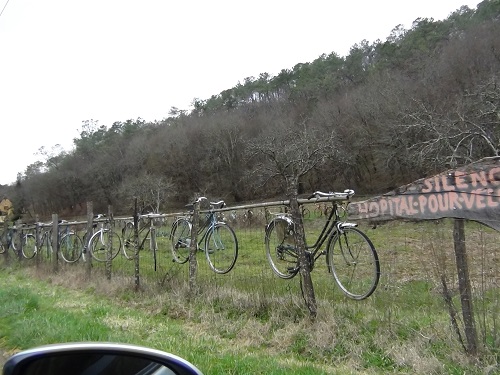
Driving we saw a yard for old bikes.
Sign says: Silence, Hospital for Old Bikes
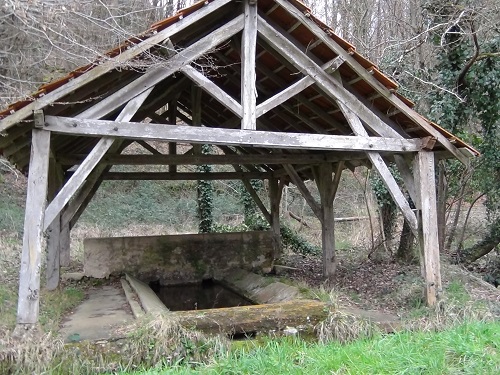
And a covered horse trough!
There is more than one of these
We saw amazing sights!
This is how they made the roof in medieval times
Soon thereafter I found out we were heading towards a castle. 
It was a castle that had a mini golf course. It had a swimming pool, and inside Josephine Baker had adopted children from around the world, and left them to grow up with servants. Unfortunately the
Château des Milandes was closed for the winter.
Les Milandes had a lot of work done on it

So we followed a loop towards home but stopped at Château de Castelnaud-la-Chapelle this amazing castle was used as a base in the 100 year war, including switching hands between the French and British. I think it was like 6 times! We had soon decided to come a different day so we could have more time to explore the castle. So we headed back and soon we were home.
This is the amazing base that was used so much in the Hundred Years War
That was great exploration!


Tuesday, March 1, 2016

Déjeuner – Erich

Today we enjoyed lunch at a restaurant. I know, that doesn't sound like much. Maybe it isn't. But this was a restaurant in a French town, and there were some similarities and some differences.

The restaurant was called Plaisirs des Sens, which means Pleasures of the Senses. It was in the town of Prayssac.

It was about 13h10 or 1:10 PM when we arrived. In France, lunch is from 12 to 14 (meaning 12 to 2). Businesses are open in the morning, close from 12 to 2, and then reopen until 6 or 7 in the evening. But the restaurants are open for lunch. And then they close and they open again around 7 for dinner. They are not the sort of come when you feel like it establishments that we are used to in the United States.

So we were on the late end of arriving for lunch. When we arrived, several tables were taken. We saw a table for four that was available, but we weren't certain if we were allowed to seat ourselves or if we had to wait for someone to seat us. Ultimately, the waiter came out from another room and we said we wanted a place for four by saying “Déjeuner. Quatre.” Quality French there. I said “Lunch. Four.” He pointed to the open table set for four and we sat down.

The entire time we were there, only this one man ever came out to interact with customers.

Next came the dilemma of menus. He didn't give us any. He didn't seem keen to give us any. Eventually, Alrica walked up to the bar, took two menus, and brought them back to our table. We hope we didn't make a faux pas in that. (More quality French.) Later, one other couple came in. They seated themselves and went up to the bar, looked at the menus there and then sat down again.

The pricing structure for the menu was a bit different. Like in the U.S. there were appetizers (which they call entrées, so I'm not sure how entrée in English came to mean the main dish. It makes more sense as an appetizer, because it basically means entry.) Like in the U.S. there were main dishes (which they call plats.) And there were desserts (which they call desserts).

You could order these a la carte. (Wow! Quality French everywhere.) And all entrées would cost the same price, regardless of which entrée you ordered. All plats would cost the same price, regardless of which plat you ordered. And all desserts would cost the same price regardless of which dessert you ordered.

But it was a better deal to get the menu. Not the paper on which the items were listed. But the menu meant you were getting a combination of these courses. So you could order a plat and a dessert menu. This meant you chose any one plat and any one dessert. And then there was a fixed price for that, regardless of which plat or which dessert you chose. And that fixed price was less than the sum of the a la carte price of the plat and the dessert.

There was also a menu that allowed you to order an entrée and a dessert for one fixed price (less than the price of the menu of plat and dessert.) Or you could order an entrée, a plat, and a dessert as a menu. This, of course, cost more than the menu of plat and dessert. You could also order a menu of an entrée and a plat. Okay, you get the idea. You could get menus that combined, in various ways, these three choices (and actually some of the menus had a fromage or cheese as a course you could choose too, but I didn't want to confuse you.)

We each got a plat and a dessert. I had magret de canard, which is duck breast. I often think of duck as being greasy, but this was not at all greasy. I enjoyed it.

For dessert, I got a tiramisu, but not a traditional tiramisu like you might have gotten before. This one had a similar top layer, but then the lower layers were liquid and delicious. The flavor was much like the traditional tiramisu I have tried before.

Alrica had a filet Julianne, which was fish, and then a flan for dessert. And the kids both had piece de bœuf, which was literally a piece of beef (steak). And they had fruit salad with a scoop of ice cream (un boule de glace) for dessert. Carver chose passion fruit ice cream which in French is fruit passion. Syarra chose menthe au chocolate or mint chocolate.

We were asked, “Cafe ou fin?”. “Coffee or finished?” We said, “Fin.” But even then, the waiter did not bring the bill. This seems to be a common theme in restaurants outside of the United States, or at least in the nations we have so far visited. I guess you have to ask for it. I went up to the bar and then he presented it to me and I paid. (No dine and dash here. We are totally above board.)

So there were many differences. But one thing was the same. Music. They played music in the overhead speakers as we ate. Nothing too loud. Nothing too distracting. But when we paid attention, we realized it was songs in English that we would hear on the radio in the United States. Love lifted us up where we belonged. And someone paved paradise and put up a parking lot.

It was a lot of fun, an interesting cultural experience. And a tasty one.

Sunday, February 28, 2016

Rocamadour – Erich

One afternoon we visited the town of Rocamadour. Rocamadour is breathtaking. The town is built into the side of a cliff. There is only one road through the town, with switchbacks and steepness. And then to travel by foot around town can involve a lot of stairs.
The view of Rocamadour from the other side of the canyon
When we first drove up to the city, we were along one side of a canyon and you could see the rocks on the other side.
All you could see at first.
But until you come around the bend, you don't see any houses. Then all at once it's “Wow!”
The "Wow" moment
Not only is this built into the side of a hill, but there is a beautiful chateau at the top, rampart walls, and a whole bunch of chapels and churches.
The ramparts from across the way
Why so many chapels in a town of not a huge population? Well, Rocamadour is a Catholic pilgrimage site.
One of many chapels
Long ago, like in the 10th Century, a man fleeing persecution came to this area to live out the rest of his life as a hermit. The French call him Saint Amadour, and Rocamadour is the Rock of Amadour. Long later, a perfectly preserved corpse was found here, said to be the corpse of the saint himself.
Another view of ramparts and the tower
Pilgrims began their journey here, but not only because the crypt of St. Amadour is here. In one of the churches, the Chappelle de Notre Dame, there is a small walnut wood statue of the Virgin Mary. This is called the Black Madonna. And it is supposed to have miraculous powers.
The tower from another angle
Pilgrims arrive at the base of the cliff and then climb over 200 steps on their knees to reach the Black Madonna. On their knees! That is dedication or religious fervor. We decided against knee abuse and just used our well shod feet instead.
That's a long way up!
The churches are a good way up from the bottom. But they are not yet at the top. The ramparts and chateau are even higher. We walked up the ramparts. Along the way is the Chemin de la Croix, or the Stations of the Cross. As you walk up the path replete with switchbacks, at each turning point there is a carved and painted relief showing one of the stages of Jesus's crucifixion. I'm not so up on the Christ story that I knew all the stages. But it starts at the first stage where he is condemned to death, continued through him falling three times, a man helping him carry the cross, a woman cleaning the blood from his face, his mother crying, and ultimately to his being placed on the cross, dying, and his body being given to his mother. (I'm sure those are not all in the correct order.) But I do know that there were thirteen stages.
Rocamadour
In addition to the man-made wonders, there are plenty of crevices and small caves in the rock face. And sometimes, there is a mix of a natural cave and man-made pillars along with it.
A cave with columns
The buildings are beautifully detailed with carvings and engravings.
So much detail
In the city are two large archway portals into parts of the town. These were from the 13th Century.
Proof of the age
One is just big enough for a small car to drive through, but is mainly meant for pedestrians.
The smaller Porte
The other is much larger, like a grand castle gate. But that one is up so high no cars are even allowed up to that point.
The larger Porte
Rocamadour is a beautiful site, and it makes one marvel at how people could have possibly built such a thing. It would be a wondrous accomplishment with today's technology. To imagine people in the 11th through 14th Centuries building all of these structures is even more amazing.

Thursday, February 25, 2016

Life as it is – Syarra


Every morning we perform the routine. Actually it is not that hard. “The hard part was in getting used to it,” I thought earlier.

There are parts that aren't fun, (like stepping in horse waste) and there are parts that are fun, (like walking the horses, or that is usually fun).

Now our routine changes by the day but, currently we get up at 7:00, the chickens are let out of their small artificially heated room, the ponies go out to pasture, the dogs are let out, the cat is fed, and the hay cobs (which is a food that the horses eat) are soaked.

Then an hour (or more) later there is the morning stables, (which maybe should be called morning barn, as it is in the barn not the stables. What do you think?) The tasks we each do depends on where the horses are. That usually is dependent on when we do morning barn, because it depends on if they are hungry or not.

After that is midday meal, where only two horses are fed. And what makes it even easier is that those two horses are either alone or with one other horse.

Currently we have a break in which homeschool and exploration is done. The type of exploration I am talking about includes grocery trips, or activities, like the grotte, that one was not so successful, but we did see a door, a very pretty door and that was the best part of that day.

Nearing 5:00 we feed the two dogs and let them out.

At 5:30 we start evening stables or barn call it what you will, in which 4 horses get fed, so we make their food bowls, feed it to them, close off the ponies because they eat too much, and leave...

An hour later we open the gate to the pasture and put a mask on one of the horses so she does not eat too much, but is able to move around.

As we are coming back we try to collect both of the dogs and we eat dinner and head back to the guest house, soon another long day is done.

When It Rains – Erich

They say, “When it rains, it pours,” and don't ask me who they is. It rained last night. That was only the beginning of one of those days. You know the kind I mean. The kind where it seems like so many things all go wrong, like they've been waiting so they could all bunch up on one day.

Statistically, I could just say, “Well, that's the Poisson Distribution. Random things tend to clump.” But it doesn't make it all better. (Now, if I could quote math instead of stats, I'm sure everything would be rosehip tea and lemon cookies. And no. I don't know why I have chosen those two items, neither of which I am likely to ingest. Particularly since I don't like tea.)

We woke up super early. Why? Well, the internet here is funny. We are so far from a city that the only internet one can get is through satellite. And it seems that in the morning, it works reasonably well. But in the afternoon and evening, you are lucky to get much bandwidth at all. Probably because you are competing with so many more subscribers in the region once they get home from school or work.

We wanted to Skype with Grandma and Grandpa. But with a six hour time difference and our need to do so in the morning here in France, it made it challenging. So we got up super early to Skype at 5h00 our time, or 23h00 the previous day their time.

Skype went fine. But we were up early and tired. And then the sky fell. Okay. Not really. But it did rain in the morning. So something fell out of the sky.

Because of the rain, one of the horses was shivery, didn't eat well, and she was clearly in a bad mood. She didn't want to be touched or even looked at. Because we were dealing with her, we didn't get one of the prep items taken care of that we needed to do for the evening feeding. (To cut the suspense, we did get her dried and walked and she is feeling much more herself now.)

Also, when there is rain in the night, that means there is a lot more poop clean up. Why? Well, the horses like to spend time at night outdoors, usually. And so their poop is way off in a pasture and need not be shoveled. But when it is cold and rainy, they spend a lot more time in the barn. And this means that the proportion of their outdoor defecation decreases, thus, indoor waste disposal needs increase.

In the middle of the day, after all the manure was hauled away, we went to Le Grotte Prehistorique du Cognace. It's a cave with ancient cave paintings. Sounds cool. We had checked the website to make sure of their hours and everything.

Unfortunately, when we got there, there was a handwritten sign on a piece of white paper that stated that from some day in November to some day in April, the site was only open, by appointment, for groups of 20 or more. All the technology available, and they didn't update the website. They just posted a sign on the ticket counter window.

Alrica said this was a lesson. We should call first. To which I replied “And hear the answering machine message in French that goes so fast there's no way we will be able to translate what it said?”

Being weak in the native tongue has a few other disadvantages. I consider myself someone who is reasonably comfortable with technology. And yes, I am getting older. I'm probably not up to date on all things. But I'm no shlub either. (I'm not sure if that is spelled shlub, schlub, or if it is a nonsense word that I made up and somehow think is a real word. Maybe the latter because spell check doesn't like either of my other choices.)

So it is embarrassing when I can't master appliances. I'm not talking about computer systems. I'm talking about appliances!

In Marrakech, we had a washing machine that sometimes would just run for hours. And you could manually stop it, but then the door wouldn't unlock and you couldn't get your clothing. You had to unplug it, turn it on, turn it off, and repeat this several times until for some reason it opened. Now, the washing machine itself didn't have words in any language on it. Just pictures. But it did tell you the brand name and model number. And we looked up a user's manual on the internet. We could have purchased the PDF of the user's manual in French had we so chosen. We did not so choose.

Here in France, if I want to use the microwave, I have to cook things in 30 second intervals. Because the only function I can figure out how to use is the “add 30 seconds” technique. And sadly, you can't boil a chicken in a microwave, even if you could figure out how to choose a time you wanted.

Why do I mention boiling chicken?

Well, the dogs normally get boiled chicken as part of their meal. And I boiled the chickens yesterday, but apparently not quite enough. So their meals were delayed. The missing prep work in the morning meant that the horses' meals were delayed. And as I type this, I am waiting on my own dinner, which, due to the delays along the line is, unsurprisingly, delayed.

Plus we are all tired and cranky. And the only silver lining I can see is that it puts me in a perfect mood to write a rather kvetching blog post. (And my spell checker likes the spelling I used for kvetching, so this time I suspect I got a real word.)

Maybe one day we will look back on this day and laugh. But, I suspect not when it rains.
Wednesday, February 24, 2016

Philosophical Thoughts While Shoveling Manure – Erich

One of the duties that comes as a piece of caring for horses on a farm is the shoveling and hauling of their waste. And poop cleanup is something new to me, not an obligation I have traditionally held in my previous career steps. But I find it an excellent time for thinking about the grander questions of the big, broad universe.

First, in the vein of you can take the boy out of the math but you can't take the math out of the boy, here is my functional analysis on the mathematics of manure.

There is a mathematical construct called a function. But to give an analogue, think of a function as a machine that takes some input and gives some output. The machine can take many different inputs, but what is important is that if you give the machine the same input more than once, you get the same output each time. Anytime you feed that same input in, you get the same output out. You can try a different input and maybe you will get the same output or maybe you will get a different output. Either is fine. But starting with the same input, you have the same output. Okay, if I haven't yet explained that to death, let me know. But I'm pretty sure I've exhausted that explanation.

Well, I was thinking of a horse as a function which takes inputs (I have to supply these) and gives outputs (the aforementioned shoveling.) So we have a function, h(x) and we know that h(hay) = poop.

But we are getting into the circle of life here. (Cue the majestic Disney music.) See, I haul the poop into a big pile cleverly referred to as the poo pile. But that poo will be allowed to compost or ferment until it becomes fertilizer. So we have a function f(x) choosing f for ferment. (Note, that in mathematics, we have favorites ranges of the alphabet for various items, and for functions, our favorite letters are f, g, and h.) And we know that f(poop) = fertilizer.

Finally, what is the fertilizer going to be used for? You guessed it! To grow more hay! So we have a growth function, g(x) and we know that g(fertilizer) = hay.

Thus, using the composition of functions, we can show that h(g(f(poop))) = poop! Poop begets poop. (In statistics, it is sometimes said, “Garbage in, garbage out.” Similar, but not the same.)

What does this tell us about the world? I guess that even what we think of as waste can be a part of making something fresh and new. But ultimately, it all goes back to being waste. It's sort of like nihilism with brief optimistic spikes along the way.

Turning away from math, I know, you're disappointed, let move to philosophy. Question, who is the dominant species: humans or horses? If you've read Gulliver's Travels, you will see some of Swift's thoughts on that matter. But what about my thoughts? I'm not as famous as Swift, but he's long dead, so I get to have my say now.

On the one hand, humans put up the fences and gates. We choose when to open the gates and when to close the gates. We put harnesses on the horses and then move them where we want them. We choose the times of feeding. We seem to make a lot of their decisions for them. Sounds like we are the alpha species, right?

But then, while I'm shoveling poop and the horses are watching me, I can't help but wonder if they are thinking “Hey, look who's cleaning up my feces! I guess we know who's the low man around here, don't we?”

So maybe it's a draw.

Still, the horses have a pretty routine existence. Same basic meals all the time. Same times in the pasture, same times in the paddock. Yeah, the weather changes, but that's about all that varies much for them. And they are perfectly happy with it.

Maybe we humans could be like that. Just okay with sameness. Okay with predictability. Less concerned about the big wide world and more focused on our immediate surroundings. Or maybe, since we think like humans and not like horses, that would bore us right out of our sanity.

So, those are my deep thoughts that I came up with while hauling manure. And maybe they aren't so deep, or so great, or even so insightful. But in my defense, I did come up with them while shoveling poop. And as I have shown mathematically, poop begets poop.

Tuesday, February 23, 2016

Hilltop City and Thousand Islands? – Erich

France is separated into départements, which are administrative regions, like being broken up into states in the U.S. We are in the département of Lot, but not too far from the département of Dordogne. And we took a little trip into Dordogne to the city of Domme.

Domme is an old medieval city that was built for defense on the very top of a high hill overlooking the Dordogne River. The architecture is old, like many of the towns in this area. There are many old buildings and crooked streets. And there are structures left over from what once must have been walls around the town.

On the way there, on the way anywhere around here, you pass by old churches and other buildings from many centuries ago.

At many of the intersections are signs, arrows pointing down varied roads with the name of the village or villages you can reach by going in that direction. And often under the village's name it will say something like eglise de XIII S. This means in that village there is a church from the 13th century. Of course, there are also XIV S (14th), and XII S (12th), and the oldest we have seen so far XI S (11th).

You see so many stone buildings that are so ancient you almost get immune to it. Almost. They are still pretty impressive to see. When you come from a country which has almost no structures standing from the 17th century, you can appreciate that there is a rich, if someone taken for granted, history here.

Traveling to Domme, you must drive up the curved road full of switchbacks that leads up the hill. And there is a warning at the bottom that there is a height restriction at the top. You have to pass under this arch to get into the town.

In Domme, there is a viewing plaza where you get magnificent views of the Dordogne River below and the plains and peaks on the other side. This is green pastoral land dotted with stone buildings. And you can follow the meanders of the river.

You can also see some of the structure of the rock on which Domme stands.

At another location in Domme, we saw the remains of an ancient guard tower which once stood as part of the city's defenses. Now, the floors which were probably wood are gone. But part of the stone structure remains.

We enjoyed a picnic in Domme, surrounded by the beauty of the landscape. And to get food for a picnic, one stops at a grocery store, right? While you see many differences in the grocery stores of varied nations, one particularly caught my eye.

In America, do we have our own particular sauce of which I am totally unaware? One that we are so proud of, we call it American Sauce? How am I so ignorant? Or is it made of Americans? Oh, that's getting to a dark place.

Before you panic, reading the ingredients, I'm pretty sure this is Thousand Island Dressing. But hey, market it however works best for you, Heinz.

I suppose, though, it is only fair. I mean, it is the French way of getting back at us for fries, toast, and vanilla. Touché, France! Touché.