Showing posts with label USA. Show all posts

Wednesday, September 11, 2024

Which Shall Not Be Named

I haven't posted in some time. Not since February, and you can read why by looking at that last post. Since then, we've been to a lot of places: All over Oregon, Seattle, the Bay area, back to Reno, Denver, West Des Moines, Cheyenne, Ithaca, outside Cleveland, and now near Charleston, West Virginia. So maybe there is a lot to cover in that time frame.

Maybe there is, but I don't want to cover it. I'm thinking about something in the future, not so much about the past.

Next week, Alrica and I leave the country. We move on to an international lifestyle, and who knows when we will come back. Okay, that's only partially, true. We know we will be back in the states in summer 2025—we have two weddings to attend—but really it is more like we will be visiting the USA, not living here.

In some ways I am excited to start this adventure, traveling abroad and this time without kids. It will be a different experience. But in some ways I am nervous about it too. I know we did this before, but somehow it doesn't feel the same.

But there is one object which exemplifies my nervous energy at the prospects before me. It's The Car Which Shall Not Be Named.

Don't you dare name this car!


For those who don't know, The Car Which Shall Not Be Named is the Hyundai that Alrica and I still own, which has taken us all around this country (and into Canada.) But also the name of The Car Which Shall Not Be Named is not The Car Which Shall Not Be Named. Because The Car Which Shall Not Be Named has no name. You see, it shall not be named.

Let me explain more fully. Personally, I am a big fan of naming cars.

  • The first car that was truly mine was named Little Red Car. Yes, it was a little, red car. And yes, that wasn't my most creative name. But that was its name. It just felt like its name.
  • The first car that Alrica and I bought together, while we still lived in New Jersey, was Primal.
  • In West Des Moines, we got a second car which did have a name, but I can't write it here, not because it must be censored or bowdlerized, but because it can't be spelled. The name was two percussive beats. What do I mean by that? Take your hand and tap a table or wall nearby twice. That was the name of the car. I recognize that name comes across as a bit crazy. But right after I got the car, I was going somewhere with Carver in the backseat. And I asked him what we should name the car, and he slapped his hand against the door twice. So that was the car's name. Sure, Alrica pointed out that Carver wasn't even one-year-old yet, and maybe he wasn't qualified to name the car. But no, it was a great name. Again, it just felt right, it was the name of that car.
  • Eventually, when we lived in Pennsylvania, our two percussive beats had to be replaced. Alrica had been driving Primal, but when we got a new car, that became hers and I started driving Primal again. This time Syarra named the new car, and yes, she was old enough to give it a verbal name which can be spelled: The Magical Car.
  • We sold both Primal and The Magical Car when we left to travel the world for two years. But when we returned to the USA we bought a used car. It's very first trip was a long one. It traveled from Boynton Beach, Florida (where we had been staying with my parents) to Lancaster, Pennsylvania (to visit friends from our life before travel) and then to West Des Moines, Iowa (to visit some of my family), and then to Harper, Texas (to visit some of Alrica's family), and finally to Reno, Nevada (where we would make our new home). So we looked up the longitude and latitude of each of those locations. We took the arithmetic mean (yes, the average, but I'm a mathematician, so get used to me being mathy or mathic) of the longitudes and the arithmetic mean of the latitudes. We then looked up that location on a map. It was in the Ozark National Forest. And so the car was named Ozark.

For awhile we only had the one car, but that became impractical. So eventually we got another car for Alrica's use. And of course, I wanted to name it. But Alrica isn't totally on board with naming cars. And she insisted that for a car to be named it had to earn its name. The problem is that no one (except maybe Alrica, and maybe even including Alrica) knows the parameters involved in "earning" a name.

We had a string of unfortunate cars there. The first car for Alrica in Reno didn't last terribly long. The kids and I called it "Her Car" or Herc for short. But of course, only when not discussing it with Alrica. The second car for Alrica in Reno didn't really last much longer. The kids and I called that one "Your Car" or York for short. Again, not when talking with Alrica. But the third car lasted! It is the very Hyundai that was and is the whole point of this post.

Even now, though we have sold Ozark and only have the one car for more than a year, we still are living by Alrica's rule that the car doesn't get a name unless it earns a name and only Alrica can determine when such a name has been earned. No worries, because the kids and I have always called it The Car Which Shall Not Be Named.

Alrica will then scold us, saying we shouldn't call it that, because that is not the car's name. And we all agree wholeheartedly, the car has no name and realistically never will. That's why we call it The Car Which Shall Not Be Named. It's not a name, it's a condition. It's a state of being.

And this past 13 months, it has been a state of being. It has been the only consistent "place" we have. Jumping around the country and house sitting is exciting. But there is a security in knowing that if anything goes wrong, a home owner cancels or the internet goes out or a meteor destroys the house—one of those is more far-fetched than the others, I will leave it to you to decide which is which—we can always hop into The Car Which Shall Not Be Named and get to a hotel, public library, or fallout shelter. (Yes, I suppose a car could also be destroyed in a meteor strike, but really what's the likelihood of that?)

In a way, The Car Which Shall Not Be Named is a safety net or a security blanket, even though it is a car and not a net and not a blanket. (Though it has a heater if we're cold, so, you know, it shares some qualities with a blanket. It does not, however, easily spread over a bed. Or so I would assume. I haven't tried.)

Before we fly out next week, we are going to sell The Car Which Shall Not Be Named. And honestly, that is the psychological barrier I can't seem to overcome. Yes, a day of flying is going to suck, but it's just a day. Selling the car, wow, that's the end of an era. That's the last string that ties us to a previous lifestyle, even though it is a car and not a string. Metaphorically cut that string and we're free-falling. Each time I think of it, my heart rate increases just a little bit. Am I scared? Not exactly. Maybe I'm anxious, here not meaning eager but instead having a smidgen of anxiety.

I guess this blog post, the first after such a long dry spell, is a salute to a fine vehicle that has driven us through storms, over mountains, on snow covered highways, and the occasional nice stretch of dry road under sunny skies. So goodbye four-wheeled friend.

I guess you'll never earn a name now. But you know what? Maybe that's the way it should be. Then you can always remain, at least in my mind, The Car Which Shall Not Be Named.

Friday, December 8, 2023

First Things, One Would Hope, First?

Back in the day, this is as opposed to now which is also day, but not the day. So, back in the day, when I was at NYU which is in Greenwich Village (in Manhattan) and Alrica was working at Scholastic which is in Soho (in Manhattan), we would often meet for lunch.

A digression for those who don’t know the layout of Manhattan. You can be comforted to know that Greenwich Village and Soho share a border. That border is called Houston Street. Two things about this: Soho is short for South of Houston, so as you might guess, Houston Street is the northern border of that section of town. The other thing, Houston Street is pronounced HOW-stun and not HUE-stun. It is not a city in Texas. It is not named for Sam Houston. I am not entirely sure for whom it is named, but whoever that Mr, Mrs, Miss, or Ms was, the person pronounced the name HOW-stun.

Now to regress (which probably isn’t the opposite of digress. Maybe to progress?) Many of our lunches were purchased at Hong Kong. No, not the one in Asia, but a restaurant conveniently close to both of us in our respective offices. Hong Kong was wonderful. It sold delicious foods such as Chicken with Cashews and Beef with Broccoli and other (Meat) with (Plant) which were not required to start and end with the same letter. Plus it was a very reasonable price.

The place had no atmosphere worth mentioning. If you wanted to eat there, you had choices of benches rather like picnic tables. But most of the time we took our food back to one of our offices or ate outside in a park. And it was scrumptious. Except the one time it wasn’t.

Once, when Alrica and I visited this fine purveyor of Chinese delicacies, we discovered the whereabouts of Jimmy Buffett’s famous lost shaker of salt. Someone had poured the entire thing into the sauces for the food made that day at Hong Kong. Our food was so salty it was inedible.

But we took it as a one-time error and the next time we returned there, the food was excellent as usual. That led me to realize (and probably Alrica too, but while I do not hesitate to speak for her in some things such as preferred ice tea making methods, I would not dare to do so in regards to realizations), it led me (us) to realize that it was lucky this was not our first trip to Hong Kong. (The restaurant in Manhattan, not the region in East Asia.)

If that had been the first meal we ever received from Hong Kong, we would have assumed that their recipes called for salt as the main ingredient and meat and vegetables as an afterthought. Why would we have possibly returned? The correct answer is: there is no reason or E) None of the Above. We would not have returned.

This supports the idiom which says you only get one chance to make a first impression. Though in this instance, that’s not entirely true. There could have been several people who bought food that day from Hong Kong for the first time. So Hong Kong had multiple changes to make first impressions, not just that day, but everyday it was open and serving meals. I suppose the more precise idiom would be you only get one chance to make a first impression per impressionable person on whom you are making an impression. But brevity and wit make it clear why the less precise version of the idiom is better known.

At present, Alrica and I are in South Carolina. My friend Jeff, who lives in North Carolina, told us we should try a fast-food chain of the south called Bojangles. I love trying regional fast-food chains. I like to see what is different, the same, and, for lack of a better term, regional, about them. Plus, if the chains ever spread nationwide, it is fun to think you knew about them when they weren’t so ubiquitous. For example, they have Culver’s in South Carolina. Of course, I remember Culver’s from living in Iowa and Wisconsin, when it was a Midwestern chain. It’s fascinating to see Culver’s locations spread like pancake batter emanating from Wisconsin and spreading across the United States. (And if you think I should have used a custard reference, rather than a pancake, I get that. But I am going back to a pancake theme below. Just have a little faith.)

Jeff recommended that we get, as our side, Bo Rounds. He accurately described the shape of them. He told me to imagine a tater tot, but someone had pounded it so it was much flatter and way more spread out. I like his metaphor of pounding it, presumably with a mallet or something malletish. As a mathematician, I would have probably said “Imagine a tater tot in which, while still cylindrical, no longer had a height greater than the diameter, but instead had a diameter greater than the height.” Mathematics is a wonderful language for expressing exactly what you mean, but it is rarely poetic.

Of course, we took Jeff’s recommendation and did eat at Bojangles on our drive to South Carolina. We got the Bo Rounds, as suggested. And while Jeff’s description did him credit in terms of shape and size, it was less on the nose about flavor. Because the moment I tasted my first Bo Round, I realized these are not a form of tater tots. No, these are latkes.

Latkes, also called potato pancakes, are shredded potato and onion with salt and other seasoning which are fried in a skillet, made almost like a pancake. (See, I promised a return to pancakes, and here it is!) It is a common food associated with Hanukkah. (Hanukkah involves miraculous oil, so foods fried in oil are a Hanukkah tradition. I’m sure even Judah Maccabee enjoyed a good jelly doughnut before revolting against the forces of oppression.) My first bite of Bo Round and I felt that ketchup was not the appropriate condiment. I hankered for either sour cream or applesauce. And given that now it is Hanukkah, how appropros!

But what I also found, at Bojangles, was Cheerwine. I had seen a billboard for Cheerwine on the road south. I didn’t know exactly what it was, but I guessed, from the aluminum cans in the picture, that it was not, as the name might imply, wine. I just think most vintners grimace at the idea of putting their product in a can. (I know there is wine in a box, though probably not your finer wines, but I am unfamiliar with wine in a can.)

Been around for 106 years and I am just learning about it?


It turns out Cheerwine is pop, if, like Culver’s, you originated in the Midwest. It is soda if, instead, like Subway, you originated in the Northeast. (On that note, and on a tangent, you would think Subway started in New York City given that there is NYC subway map wallpaper on all the stores. But no, it started in Bridgeport, Connecticut. Yes, that’s still the northeast, but it makes you wonder if this is a tepid form of cultural appropriation.) And if, like Bojangles, you originated in the South, you probably think Cheerwine is a kind of coke.

Regardless of the regional term you use for fizzy soft drinks, Bojangles has Cheerwine in the self-serve soda fountains. And I wanted to try it, and it was great. It is a cherry soda, refreshing and bubbly. But why do I bring this up?

Because a week later, I had a second chance to get Cheerwine from a soda fountain. And I found it wanting. It was barely any of the red cherry syrup and way too much of the colorless carbonated water. Bleah! Not good, let me assure you.

But, like Hong Kong, I realized how fortunate it was that this was not my first encounter with Cheerwine. I knew this was just a problem of that particular soda machine having too little syrup, either through the bag running out or a problem in the brix. (Aren’t you impressed that I know a technical term like brix? It refers to the ratio of the soda syrup to the carbonated water, so it is exactly what I want for this paragraph. And so many people told me my trivial knowledge would never be useful. Ha!)

Had that been my first drink of Cheerwine, my first impression, I might have disdained it. I might have declined future chances to repeat the experience. But having found it to my liking the first time, I know that this was more likely the fluke, and I will return to Cheerwine at some future opportunity.

This makes me wonder. How many things are there in the world that I think I dislike, but really it is a matter of my first experience with that thing being a negative one? I will give you an example: shrimp. Mom, if you are reading this, I love you very much and I enjoy many of the wonderful recipes you made for our family when I was growing up. But not your shrimp. For years, I thought I didn’t like shrimp and I wouldn’t eat it. It wasn’t until college, while dating Alrica, that she convinced me to try shrimp. I was surprised to find that I enjoyed it. It turns out I don’t dislike shrimp. I just didn’t enjoy the way my mother made it the first time I had it. That initial encounter led me to an erroneous conclusion. How many other such erroneous conclusions have I come to on the basis of a sample size of one?

I have tested some of my dislikes to be sure they are not just a one-time affair. For example, I am positive there is some chemical that cucumbers and melons have in common which most people seemingly cannot taste, but I can. And its flavor is reminiscent of a sour citrus juice which was breaded in baking soda and ashes, then left to rot in a tomb for a few centuries, and then reintroduced into the offending flesh of the fruit or vegetable (though horticulturally, cucumbers are also fruits.) I am also fully convinced that tea is a revenge plot by trees in response to the incessant human desire for paper and two-by-fours, offensive to taste buds, and probably a ploy by the sugar industry to maintain their profitable business.

But now think grander than just foods and beverages. Are there places that someone doesn’t like because of bad first impressions? Are there religions that some sectors of society demonize because of early impressions, possibly even those not personally experienced? Is this the root of bias, implicit or explicit?

I know I am a mathematician, not a sociologist. But how important are those first impressions on our way of thinking about big, important things? Can we overcome them with a good second impression, like my experience with shrimp? Or are some things so ingrained that we won’t allow ourselves to take that second chance?

Well, this is heady stuff now, way beyond Hong Kong and Cheerwine. But to paraphrase Jimmy Buffett:
I’m wastin’ away again in First Impressionville.
Hating foods with whole shakers of salt.
Some people claim that there’s whole subgroups to blame.
But I need to reset default.

Thursday, November 23, 2023

The Fourth Thursday

Today’s the fourth Thursday. It’s likely I may
Be asked, now, for what are you thankful today?
And I guess, if you asked that, here’s what you’d be told.
I’m glad that I don’t have to stay in the mold.

This life where we nomad
And somehow don’t go mad
Come and go without pomp, without guilt
Though it’s plenty of fun,
It’s not easily done
‘Cause it’s not how America’s built.

Not to say we are homeless, but home we have not.
And a home is expected for really a lot.
Car registrations
And voting locations
Depositing royalty checks for creations.

There isn’t a system to do those with ease
But that is the price for the life that I please.
So I’m thankful that, even though sometimes it’s wild
We are able to live this way: undomiciled.

Tuesday, November 21, 2023

A River Cuts Through It

Here is an amazing story of geological history. And it began around 270 million years ago (give or take). It’s a pretty dramatic beginning too because the African plate and the North American plate collided. (Neither of the continents looked exactly as it does today.) This occurred on the eastern side of the North American plate, pushing massive volumes of rocks to the west. These rocks crunched and bent and piled and became… (any guesses?)

This rock pile became the Appalachian Mountains, version 1.0. These were big mountains. We’re talking size of the Himalayas big.

Then what happens? Erosion, same as is happening now. But this is the part I never knew before. Over millions of years, the Appalachian Mountains eroded away completely, down to the roots of the mountains. So, the Appalachian Mountains of that time would be better called the Appalachian Plains.

Those of you paying attention should be saying, “Wait a sec, there are mountains there now!” Yes. The movie is never as fun if you already know the ending. Like when I saw the movie Titanic, I already knew the giant squid was going to win. But, unlike that story, there is an interesting twist to our already known ending.

In the time of the Appalachian Plain, there was a river called the Taeys River. (Taeys rhymes with daze or maze or the phrase that pays.) The river began in what is present day North Carolina and ran northwest, which was downhill at the time. It flowed through present day Virginia, then West Virginia, and then into Ohio. It flowed as far north as what today is Columbus and then turned west. Here it ran through the middle of what is now Indiana and Illinois before turning southwest and hitting the Gulf of Mexico.

Again, if you’re paying attention, you probably think, “It must have gone through some other states before hitting the Gulf, right?” Surprisingly, no. The Gulf of Mexico stretched as far north as present-day Illinois in that time.

So yes, the Taeys River is very old, but you are justifiably asking, “Why is the Taeys River the twist of the story? And you still haven’t explained why there are mountains in this supposed plain!” Calm down, reader, I’m getting to it.

The Appalachian Plateau started to rise again, buoyed and thrust by magma from the Earth’s mantle. But the rise was very slow. Geologically slow. While this changed the courses of some rivers, not so the Taeys. The Taeys River managed to cut through the land at the same rate that the land was rising. So it isn’t that the Taeys cut down to form a canyon, but rather that the land rose on either side of it forming the canyon. Meanwhile the Taeys River stayed pretty much where it had already been. It survived the rise of the Appalachian Mountains 2.0.

However, while the river survived the rise of the mountains, later, the downstream part of the river wasn’t so lucky. Though it wasn’t mountains that wiped it out, rather glaciers. Glaciers came down through Ohio and Indiana and Illinois. They pushed earth and rock and filled in the channel that the Taeys River took through those states. In fact, the earth pushed by the glaciers dammed the Taeys River. A huge lake with several fingers of water was formed called Lake Bright along the present day border of West Virginia and Ohio.

Eventually Lake Bright got too full and had to go somewhere. A new outlet formed that tumbled down the present-day path of the Ohio River. From then on, the downstream part of the Taeys was gone.

That wasn’t the last change to the Taeys. When a new river out of the Appalachian Mountains formed, the Gauley River of West Virginia, it met the Taeys and changed the course of the Taeys downstream of their confluence. That new path is the present-day Kanawha River which runs through Charleston and eventually to the Ohio River. Interesting note: Kanawha is pronounced K'naw.

Still, the upriver part of the Taeys, the part that runs from North Carolina to the junction with the Gauley River in West Virginia, that part is still in its same bed. It is the oldest river in North America and one of the oldest in the world. Some geologists believe it may be the second oldest river in the world, second only to the Nile River of Africa. (Presumably, everyone knew where the Nile River was, but clarity is a virtue.)

This river is the only river that cuts across the Appalachians. It begins east of the mountains, but cuts through them and drains out to the west of the mountains. Not many rivers in the world do that!

One final note for the readers, who, as I mentioned previously, are paying attention. I would like to think that is many of you, but let’s be realistic. Still for those intrepid few, if you go looking for the Taeys River on a map or a globe or most likely the internet, you won’t find it. Because that isn’t its modern name.

And here is the irony: The river that run in this ancient bed, the oldest in the continent, the one that survived the rise of mountains, it’s called the New River. That brings a different meaning to the idiom “everything old is new again.”

The New River Gorge


We got to experience that amazing canyon that formed as the Appalachian rose around the river while we were in West Virginia. It is called the New River Gorge, and it is a national park. If you are ever in the area, you should check it out and know you are standing in a place not only of history, but prehistory. Really even pre what we usually call prehistoric. Though not so pre-prehistory that its primordial. Maybe just ordial. For those who are paying attention.

Sunday, October 29, 2023

Authentic Chili Diving

When I was in college, my roommates and I made a distinction we called swimming vs. diving. It will likely come as no surprise that this definition came about while the Summer Olympics were going on. None of us were likely to achieve our dreams of standing on the awards platform, so we found tangential ways to be a part of the events.

The distinction between swimming and diving is this: In swimming events, meaning the races where you must do the breaststroke or backstroke for so many meters, there can be little argument about who wins the event. The person who swims the required distance in the minimum amount of time is the gold medalist. This is as opposed to diving which requires judges to give scores and hold up their scorecards. These scores are summed and the person with the highest total wins.

But the number of points given by two different judges who just watched the same dive may not agree. There is an element of subjectivity here. In fact, the entire event is subjective. Why is a small splash better than a huge splash that wets the first three rows. (This is transparently biased against breaching whales trying to enter the Olympics.) What determines if an tuck is more difficult than a curl (or whatever the terms in diving are.)

At some point, a group of self-proclaimed diving gurus decided upon the rules, what was good, what was bad, what was ugly. If a different group of gurus had decided upon the rules, the event might look very different. Well, the scoring would look different. The fundamentals of leaving a board and going downward into water would be the same. We can't overcome gravity. Even if the same group had decided upon the rules after having a very unpleasant meal, the event could look very different. This means the rules in diving are not only subjective, but arbitrary, as opposed to swimming where fastest is fastest and slowest is slowest and never the twain shall meet, because if they met, slowest would be going as fast as fastest and wouldn't be slowest, would it?

This post is, at its core, about several authentic experiences I had recently. But I want to make clear one point: Authenticity is diving. It is like deliciousness. It is possible for two people to eat the same thing and for one to say, "That's yummy," while the other believes the victuals have strayed far from delicious, tasty, or even palatable. 

Case in point: I made chili today. I would rate my chili's deliciousness at about a 5.5, but my wife would likely give it a 2 or less. I used too many jalapeños for her liking. There's an irony there. The very ingredient which, arguably, makes the chili authentic (namely, the chilis) is what detracts, in my wife's mind, from its deliciousness. So deliciousness is clearly diving. It is subjective, arbitrary.

I claim authenticity is similarly diving. So when I say, as I am about to say, that I had authentic experiences, you may disagree. It's just my arbitrary vision of what is authentic to various locales or foods or experiences.

Even above, when I said chili peppers are what determine the authenticity of chili (which does seem to follow from the name), that's still very diving of me. Just look at the insistence of Texans that real chili has no beans and the rest of the country's acceptance that beans are normal in chili. You can see that authentic chili has no universally agreed upon set of ingredients. (Or go to Iowa and get chili with a cinnamon bun, or go to Wisconsin where it is served over spaghetti. There's a lot of region flexibility to chili.)

I think the point is made. Let's move on to the experiences, shall we?

In Schenectady, NY, which is very fun to spell, Alrica and I had lunch one day at a place called First Prize Mike's. Alrica got a burger, I got a hot dog and a shake. We both had onion rings. The food was fine, not incredible, not bad, but fine. But the experience was so New York.

First Prize Mike's is laid out like a diner. It is long and narrow with a big bar around the open kitchen and then there are booths on the wall opposite the open kitchen. But it was the people who made it such an experience. The employees: cooks and wait staff, constantly razzed one another, griping that each was making everyone else's job harder to do. The waitress called her patron's "honey" and treated them like she'd known them all her life. She probably had known some of the regulars for a long time. But Alrica and I were first-timers, and we got that treatment too. It took forever to get our food, my chocolate shake, when it arrived, was strawberry, and when I tried to clean up my own table, I got scolded for taking away my waitress's job. It was fantastic, fast-talking, and friendly in that authentic matter-of-fact New York style. Or at least what I consider authentic for New York. It felt authentic to me.

When we traveled from Schenectady, NY to Cambridge, MA, we took a scenic route. This led us through country roads in Vermont. It so happened that we passed by a huge outdoor farmers' market and so we stopped. This market was so Vermont (a diving statement if ever there was one.)

What do I mean? The port-a-potties were sawdust compost toilets. If you bought food to eat on site, the utensils were all wooden or cardboard so they could be recycled. (There were multiple kinds of recycling at the recycling station, so you had to figure out which bin your utensils went into.) One vendor made a point to tell me that everything sold at the market was made or grown by the vendors selling at the market. And I found my fashion peeps, or at least I could camouflage as a Vermonter.

I like to wear t-shirts. I find them comfortable. But I do make concessions to the temperature. And one of those concessions is that when it is nippy, I put on a flannel shirt over my t-shirt. Usually I leave it unbuttoned in the front. For some reason I don't entirely know, the vast majority of flannel shirts are plaid. Mine are no exception to that rule. (In fact, now that we live out of a car and backpacks, I only have one flannel shirt. And it is plaid.) So, point being, I was wearing my plaid flannel shirt over my t-shirt.

Proof of my flannel shirt (and my ugly hat (and the Mohawk River))


As I looked around, I was astonished to see how many of the men were wearing plaid flannel shirts. (They did not have them open in front.) But by buttoning up my plaid flannel shirt, hiding the t-shirt beneath, I became one of the crowd, indistinguishable from lifelong Vermonters (or at least I couldn't distinguish between them and me, except I have the secret knowledge that I am not now nor have I ever been a Vermonter.) It's possible that the Vermonters could tell I wasn't one of them, but if so, I don't know what gave it away. I was certainly wearing the uniform.

You could argue this is more about stereotyping than a quest for authenticity. You might be right, but they were all dressed in plaid flannel. You can't take that away from me. That's swimming.

Alrica talked to a sugarmaker (a person who makes maple syrup, but isn't called a syrupmaker) about what causes the different grades (colors): golden, amber, dark, and very dark. Spoiler: It's bacteria. We got hot mozzarella (on a compostable wooden fork, of course) which is an entirely different experience from not hot (though not exactly cold) mozzarella, or so we were told by the cheesemaker (a person who makes cheese, though that word was pretty self-explanatory.)

Authentic Vermont, right? Unless you have a different definition of Vermontiness (or maybe Vermonticity,) which is totally diving of you.

In Charleston, West Virginia we visited a fast-food restaurant called Tudor's Biscuit World. (Sadly, people who make biscuits are not called biscuitmakers. They are called bakers. But it rhymes.) The biscuits were great. They are served with a variety of things inside, mainly products of pork, cheese, and potato. Definitely delicious (diving) and arguably authentic (diving).

Regardless of whether or not you agree with my various diving arguments, we all must concur that I need a deep dive into the leftover chili. I'm not likely to get much help in eating it. That's okay, because I think its reasonably good (diving), but not really good enough for a chili cook-off (which is completely a diving event.) Though maybe I could train for the Leftover Chili Eating Olympics. Then, just like all those years ago in college, I can dream about being an Olympian.

Thursday, September 21, 2023

Spy vs. I

We wandered a museum devoted to the spy.
Those spies, you may not see ‘em, adrenaline is high.
Such craft to learn, and assets turn, and drones to glide and fly.
Would I become a spy, they asked. Now I’m asking, “Why?”

Are you a wandering ranger? Yes
Are you seduced by danger? No
Do you like solving puzzles? Yes
Do you like guns and muzzles? No
Are you good with disguises? No
Do you watch for surprises? No
A fan of obfuscation? No
Or one who’d serve his nation? Now, hold on a minute.

Is what I do any less important to the nation than what a spy does? I’m not sure that it is. But for comparison’s sake, let’s say we are talking about a really good spy, one who obtains critical intelligence that saves many lives. We won’t talk about the ones who turn on the country or who cause civil unrest in a foreign land that comes back to haunt us twenty years later.

What do I do in comparison? I help people to learn mathematical techniques that will propel them through college. And I would like to think maybe it gives them vital skills that will prove useful in their lives. This isn’t to say I think they will all be differentiating functions or writing proofs by contradiction. But I hope they will be thinking not only about what things are like now, but how they can change (and how we can predict that change.) I hope that when presented with some supposed “fact” that they can think critically, be a skeptic, and analyze it to determine if it is true or not.

It is like the parable of the frog in the pot of water. The story says if you drop a frog in a pot of boiling water, the frog will jump out immediately. But if you put the frog in a pot of room temperature water and then heat it up to boiling, the frog will stay there until it’s boiled.

This is a story. Remember the analyzing-something-to-determine-if-it-might-be-true-or-not? Well, this doesn’t ring particularly true to me. The slowly heating water will eventually start to hurt and the frog will notice that and jump away. That’s how it seems to me.

And then I did a bit of research. I am not the first to ask this question. Guess what, I was right. Frogs thrown into boiling water may jump out, but they will be badly hurt by the time they can do so. Frogs in room temperature water that is being heated will jump out before it gets hot enough to hurt them.

You might wonder, what do frogs have to do with spies?

The spy is the hero of the moment. At that one moment, Spy gets crucial information and saves lives. Or if Spy is of the James Bond type, Spy defeats Villain and saves lives. We think that is impressive, because we just judge the spy in that moment. We ignore the months of slogging or undercover work. We ignore all the times the spy lied or hurt people who got in the way. That moment is hitting the boiling water and we frogs jump out (meaning we give our congratulations to the spy.)

But the educator is the long-slogging hero. There’s not one moment that defines it. But through the many lessons, the years of influencing students, the knowledge that has been obtained, bit by bit, Educator changes our nation, hopefully for the better. Sometimes, like Spy, for the worse.

Almost everyone can remember that teacher who touched their life and gave them a new idea, a new confidence, a new outlook. Almost everyone can remember that teacher who put them down, made them doubt themselves, or turned them off a subject. (I’m looking at you, math.)

But this is the slowly heating pot. Since it isn’t one moment of huzzah, we, as a society, don’t see it, we don’t celebrate it.

In 2001, someone sent some anthrax through the mail. Four such letters were sent. Four out of over 100 billion letters that are sent in a year. I need not tell you, that is a tiny, tiny percentage. (Maybe I do need tell you, if you were turned off from math at a young age.) Yes, this was terrible to imagine what could happen. And because it was short term terrible, we spent billions of dollars refurbishing the postal distribution center. I’m sure that saved some lives, a few lives.

Climate change is happening, slowly, creeping along. And it is killing people all over the world. It is changing economics in region after region. It is causing droughts and floods and gigantic hurricanes. And yet, we do little about it. In some state governments, we have done more to ban a state employee acknowledging the existence of climate change than we have done to help people affected by it.

Why is that? Because anthrax is the boiling water and climate change is the slowly heating pot.

This isn’t about the museum. If you are ever in Washington, D.C., you should go to the Spy Museum. It is amazing, interesting, and there are so many stories you either only half knew or never heard of that will make you gape.

But don’t forget those slowing heating pot professions that make your life as good as it is: road work crews, trash collectors, water treatment plant operators, electrical line maintenance workers, researchers, engineers, oh, and teachers.

So ask me, “would I be a spy?” I’ll say no, through and through.
But I would like to ask the spy, “Would you do what I do?”

Saturday, September 16, 2023

Howe vs. Yankovic

Long ago, in this very blog, I posted about something I discovered which I called Ordinal Awareness Fallacy. It is when you assume that things happened in the same order that you knew about them, but they didn’t.

That particular post was when I first encountered a pomelo, a citrus fruit somewhat like an orange. I assumed that a pomelo was hybridized from an orange and some other fruit. But when I did some research, I found out I was exactly wrong. The pomelo came first. In fact, the orange is hybridized from a pomelo and a mandarin.

But I had known about oranges my whole life and only recently encountered the pomelo. And that’s where the fallacy came in. Just because I knew about one of them first doesn’t mean it existed first.

I recognize that I may not be the first person who ever made note of this phenomenon. Maybe it has been written about before, but I didn’t know about it before I discovered it. So I could have Ordinal Awareness Fallacy about Ordinal Awareness Fallacy.

But I also had Ordinal Awareness Fallacy about something else. Here at the Harpers Ferry National Historic Park, we went to the John Brown Museum. It is about John Brown, his life before the raid on the U.S. Armory, the raid itself, and the aftermath of the raid including his death. In one of the videos at the museum, there was a chorus singing “John Brown’s Body.” It goes like this:
John Brown’s body lies a-mouldering in the ground.
His soul is marching on.

You may have guessed, it is to the same tune as The Battle Hymn of the Republic. So I assumed that someone wrote new lyrics to the existing Battle Hymn of the Republic, but about John Brown. I was wrong on both counts.

John Brown's Fort - where he made his last stand


The Ordinal Awareness Fallacy is that John Brown’s Body existed before The Battle Hymn of the Republic. However, it is also a set of new lyrics to an older song called Say Brothers, Will You Meet Us?

But I was also wrong that the song was about John Brown, or I was sort of wrong. The origin of the song is way more interesting.

The lyrics were written, originally, by Union soldiers in the Massachusetts Volunteer Militia. They had a sergeant named John Brown. What amused them so much was that John Brown the abolitionist was a larger-than-life figure, depicted as gigantic, with powerful arms, an unwieldy beard, and blazing eyes of judgment. Whereas Sergeant John Brown was small, quiet, and even-tempered. It was this juxtaposition that so amused the soldiers of the Massachusetts Volunteer Militia, and that led them to write the lyrics. The body a-mouldering in the ground was John Brown the abolitionist. The soul that was marching on was the mild-mannered sergeant.

The song caught on with other Union regiments, and they wrote more lyrics, bawdier lyrics, bloodier lyrics. Eventually it was being sung by soldiers who had no idea it was about Sergeant John Brown. They thought it was only about the abolitionist. And it became very popular among Union troops.

Writing new lyrics to existing songs, that’s something I enjoy. I am a big fan of Weird Al Yankovic, Allan Sherman, and Spike Jones. These are just a few of the artists who have engaged in the practice of song parodies. The idea goes back millennia. In fact, the word parody comes from the ancient Greek para (beside or altered) and ode (song). Parody songs are funny. Even in Ancient Greece where the word parodia referred to burlesque songs. (So maybe they weren’t all funny, maybe they were dirty. But that was probably funny.)

But how did this bawdy song become The Battle Hymn of the Republic? Julia Ward Howe was a published poet of some repute at the time of the Civil War. She was in Washington with some other dignitaries and was invited to see a marching and inspection of Union troops. And while the soldiers were marching, some of them were singing John Brown’s Body.

One of Howe’s colleagues, a reverend, suggested that she write “better lyrics”, probably meaning cleaner ones. And she did, the very next morning. Howe said that she woke up in the middle of the night with words in her head, hastily jotted them down, and then in the morning discovered she had written The Battle Hymn of the Republic. That’s an amazing story that must have involved a lot of midnight jotting, because the full song has five verses (plus lots of glory, glory hallelujahs.)

The song was soon published and became a huge hit among Union supporters. It also became wildly unpopular in the south, because the song placed God on the side of the Union. It reframed the war as a war for what was capital R Right and capital G Good. For example, in verse five there is a line that reads “As he died to make men holy, let us die to make them free.” (The “he” in that sentence is Christ.)

So here is the question I pose to you. What do you call this, writing lyrics to an existing song but not to make it funnier? Rather to make it more serious? It’s not parody, right? Maybe intrody? Serody? Dramody? (I suppose that’s too close to dramedy, which is already a thing.)

I don’t know. But it is not the same fine art of the Honorable Yankovic and Squire Sherman. It is another fine art of its own.

And I wonder if I am wrong about assuming that parody songs came first and serody songs came second? I am drowning in my own fallacy. Or someone else’s.

Friday, September 15, 2023

Happy Accidents

You know how Bob Ross, while painting, would talk about happy little accidents? There were no errors, because you could make the error into something that seemed intentional.

We experienced our own happy little accident, though it wasn’t any sort of error. Alrica and I are staying in Harpers Ferry, West Virginia at the moment. And here in Harpers Ferry is the Harpers Ferry National Historic Park. Naturally, we wanted to visit that while we here and we waited until the weather was going to be very nice to do so.

So it turns out we first went to the park on September 14. This, so it happens, was a happy little accident. The Harpers Ferry National Historic Park commemorates many things. Certainly high among them is John Brown’s Raid on the U.S. Armory that was once here. But it also marks various battles from the Civil War in which possession of Harpers Ferry changed hands.

You see, Harpers Ferry is a very strategically important point. The Shenandoah River and Potomac River meet here and then flow downstream, as the Potomac, through the Blue Ridge Mountains. This pass cut by the Potomac River is the only easy way through the Blue Ridge Range. So it became an important transportation center, basically a bottleneck.

Yes, the view is from a cemetery, but it is a view of the
Potomac cutting through the Blue Ridge Mountains


The B&O Railroad (for you Monopoly fans) connects Baltimore with the Ohio River. (Hence its name, Baltimore and Ohio Railroad.) And how does it get through the mountains? Right through the pass, following the Potomac River and passing through Harpers Ferry. Also, the Chesapeake and Ohio Canal (called the C&O Canal) followed the Potomac River. And the Winchester and Potomac Railroad ran along the Shenandoah River until it met the Potomac River in Harpers Ferry.

The Rivers and States
All this transportation made Harpers Ferry a big prize. To control your supply lines, it's nice to control the trains and canals. Add to that the fact that Harpers Ferry is right at the border between the Union (West Virginia and Maryland) and the Confederacy (Virginia) and this area saw more different battles than most anywhere in America. It is estimated that Harpers Ferry changed hands eight times during the Civil War.

The biggest of these battles took place when General Robert E. Lee invaded the north. He was on a winning streak in battles in Virginia and decided to take the war into the Union’s lands. This is going to lead to the Battle of Antietam (as the Union soldiers call it) or the Battle of Sharpsburg (as the Confederate soldiers call it). But before that occurred, Lee wanted to capture Harpers Ferry from the Union garrison that was stationed there.

Here comes the happy accident: That battle took place September 13 through 15, 1862. So we happened to go to the national historic park during the anniversary of that fight. Because of that, we were treated to special ranger programs about the battle.

We went up to Bolivar Heights where the Union troops were stationed. Interesting note: Bolivar Heights is in a town called Bolivar which borders Harpers Ferry. Before the town incorporated, it was usually referred to as Mudfort. But the people didn’t want that to be their city name. So they asked the state of Virginia (it was still Virginia at that time) to incorporate as the town of Washington. But the State of Virginia had so many places already named Washington that they said, “Not gonna happen.” The people had to come up with another name.

This was in 1825, when Simón Bolivar was in the news, liberating South American colonies from Spanish rule. So they asked to incorporate as Bolivar. Except newspapers don’t give pronunciation guides. So the local name of the place is pronounced Bolliver, rhymes with Oliver.

On Bolivar Heights we met Ranger George. He hiked us down the heights to the skirmish line. He hiked us back up. He told us about stages of the battle, how Jackson (confederates) outflanked Miles (union), about the different regiments there, about the Union surrender, and then about the hard march of the confederate soldiers to Sharpsburg, Maryland. After their decisive victory in Harpers Ferry these exhausted men would have a pretty rough defeat two days later.

It was fabulous. There were plenty of signs to tell you about the battle. But the ranger gave lots of extra information, answered questions, described it and how the land looked then, and made the story come alive in a way that the signs couldn’t have.

So just like Bob Ross assured us, sometimes accidents work themselves into something beautiful.

Tuesday, September 12, 2023

A Tale of Two States

When I first got to NYU, I was waiting in line to get my NYU ID Card. Also in line with me were a young man and a young woman chatting about where they were born. And I heard the young man say, “I was born in West Virginia or East Virginia. Whichever one of those is a state.”

I’m thinking, “You don’t know what state you were born in? You are an incoming freshman at a university, meaning you presumably made it through high school, and you don’t know whether or not the U.S. has a state called West Virginia or East Virginia?” I sometimes wonder what happened to that young man, if he made it through college, if he knows his address or if he lists it as being in North Connecticut or Old Hampshire or Rhode Isthmus.

I happen to know which of those two is a state. In fact, I happen to be in West Virginia right now. Today, Alrica and I visited Charles Town, WV (not to be confused with Charleston, WV. Unlike West Virginia and East Virginia, both of those exist.) Charles Town was founded by Charles Washington, younger brother of George Washington. And one of the sites we saw in Charles Town was the Jefferson County Courthouse.

The Jefferson County Courthouse


This courthouse has an interesting claim to fame. It is the only county courthouse in America which has been the site of two different treason trials against two different states. How is this possible?

Before the Revolutionary War, the colony of Virginia included both present day Virginia and present day West Virginia. When the Constitution was ratified, this entire area became the state of Virginia. At some point after this, the counties of Virginia in the Shenandoah River Valley and further west wanted to form their own state, to be separate from Virginia. They didn’t feel that Richmond represented their interests. But this was a non-starter. The U.S.Constitution didn’t allow new states to be formed from old states unless the old state said, sure, you can leave. And naturally Virginia wasn’t keen to let this northwest part go.

Enter John Brown. Brown was an avid abolitionist. He believed slavery was an offense against God. On the other hand, he was okay with murder if the people he were murdering were slavers or pro-slavery. Brown came to Harpers Ferry, Virginia with a plan. He gathered men together to complete his plan. And then one October night in 1859, he and his 21 men attacked the U.S. Armory in Harpers Ferry.

They captured the Armory, killed a couple people, freed slaves, and then abducted Armory employees when they arrived to work the next day. The townspeople didn’t take too kindly to this. They began firing on Brown and his raiders inside the Armory. Deaths ensue, but the townspeople managed to oust Brown from the main armory. He and some of his remaining raiders took refuge in an engine house.

The next day, a party of U.S. Marines arrived in Harpers Ferry. They raided the engine house. One marine was killed, but they prevailed. Brown was terribly wounded, but alive. And interestingly, who led that party of marines? General Robert E. Lee.

This leads to the first treason trial at the Jefferson County Courthouse. John Brown and his raiders were convicted of treason against Virginia and they were hanged. And yet, many Americans felt that Brown was right (not necessarily to kill people, but to rebel against a government that allows slavery.)

Of course you know what happens just a few years later: The Civil War. But this has an important implication for the people in the northwest counties of Virginia.

In 1861, Virginia held a Secession Convention and decided to secede from the Union. This was overwhelmingly popular in Virginia as a whole, but not as popular in the northwest part of the state. Lawmakers there held a convention in Wheeling. They stated that the Virginia Declaration of Rights said that any substantial change in the government of the state had to be approved by the people, not just the legislature. This was certainly a substantial change. So the Wheeling Convention said that the lawmakers of Virginia had broken Virginia Law by seceding without making sure it was the will of the people. So the people in Wheeling established the “Restored Government of Virginia”. They elected their own governor and other officers.

Now there were two different governments claiming to represent Virginia, one in Richmond which had seceded and one in Wheeling which said, “We do not secede!” The federal government chose to recognize the “Restored Government”. And one of the first acts of this restored government was to grant permission for the northwest counties to form their own state separate from Virginia.

Originally this new state was going to be named Kanawha, named for the Kanawha River. But there was already a county named Kanawha County. Many lawmakers were worried there would be confusion if there was a county in a state with the same name as the state. Besides, most people in this new state considered themselves Virginians by birth. So the name West Virginia was chosen instead. It became the first of two states to be admitted to the United States during the Civil War. (I bet my friends in Reno know what the other one was.)

What about the other treason trial? In 1921, a group of coal miners in West Virginia wanted to unionize. The coal mine owners didn’t want to allow them to do so. The owners hired strikebreakers and were also backed by law enforcement. The miners armed themselves and confronted the strikebreakers. The ensuing melee is called the Battle of Blair Mountain.

The Battle of Blair Mountain is the largest labor uprising in the history of the United States. It is also the largest armed uprising that has occurred in America since the Civil War. The miners had numbers, but the strikebreakers had better arms. Eventually the miners lost, but many people were killed in the process.

Though the fighting had occurred in southwestern West Virginia, the leaders of the labor movement were put on trial in northeastern West Virginia. Guess where? The Jefferson County Courthouse. It was another trial for treason, but this time it was treason against West Virginia. One of the miners’ leaders, Bill Blizzard was acquitted of the charge of treason. He was tried first as the state thought it had the best chance of convicting him.

In the end, one miner, Walter Allen, was convicted of treason and three other men were convicted of second-degree murder.

It’s an interesting distinction for a courthouse that didn’t move but still changed states. And unlike the young man at NYU, it knows which state it was born in and which state it is in now.

Wednesday, August 16, 2023

Unholy Green

A song about Chicago hot dogs and homage to Howard Ashman. To the melody of Somewhere That's Green. You can click on the video if you want to hear me singing it. (Not necessarily saying that will be better. But you know, it's up to you.)


A hot dog made of beef
A bun with sesame
With peppers and tomatoes
And diced onions I can see.
A pickle spear and relish
Like none I've ever seen
With a color you might name
Unholy green.

It's brighter than the hue
Of leaves on summer trees.
It's shinier than Kelly
And darker than split peas.
The taste is not like spinach
Nor sweet like nectarine
No other food is this
Unholy green.

The hot dog makes it juicy
The onions make it sweet.
The pickle makes you pucker
And the peppers bring the spicy heat.

So if you are around
Chicago, Illinois
You ought to try their hot dog,
A taste you might enjoy.
But when you see the relish
You'll wonder what machine
Could make a plant based food
Unholy green.

Sunday, August 13, 2023

All My Sisters and Me

First, I must clear the virtual air and admit that I have no sisters. I have a brother and no other siblings. The title of this post is a reference to the song "We Are Family" which continues with "I got all my sisters and me." Even sisterless as I am I have the temerity to use the reference. I throw myself on the mercy of my readers as they judge me for my allusionary (or is it allusory) prowess or lack of prowess.

For the past week, we have been visiting family as we traverse the middle of the country. First we visited my aforementioned brother and got to see our niece and two nephews. Then we visited my aunt and three generations of cousins descended from my aunt. From there we visited one of Alrica's cousins. And in a couple days we will see one of her aunts. That journey will have taken us from Mountain Time to Eastern Time (currently in the middle of those in aptly named Central Time.)

There are so many commonalities in families. Don't overgeneralize from my statement. Families are all very different. Even separate branches of the same extended family have their unique history and interactions. But it is those differences, those quirks, which inform the similarities.

I suspect every family seems pretty eccentric to outsiders. My wife's family will always be a bit inexplicable to me. I'm sure my family seems equally exotic to her. And yet, it works. Families make it work.

When Alrica and I married, we both inherited new sets of relatives. We didn't have a good grasp on the history, the personalities, the past conflicts or triumphs, not the intergenerational issues. And now we are each a part of the other's family, writing our own history, bringing our own personalities, and developing new conflicts and triumphs. (What about new intergenerational issues? Ask my kids or my parents or my in-laws. Probably, yes.) For better or worse, she's a Goldstein. And I'm a Green. (As Kermit might tell you, that's not always easy.)

But in the same breath, it's great. We've each also gained new loved ones, new friends we can enjoy, new family who will always open their doors to us as though we had been born into their clan. I have a great time talking philosophy (and other esoteric topics) with Alrica's cousins we just visited. Alrica got to help my cousin choose paint samples. And the new baby who is my first cousin twice removed is just as much Alrica's cousin. There was plenty of snuggling to reinforce that.

Alrica with the first of a new generation

My point? (It's optimistic of you to think I have one. Thank you.) I may not have all my sisters and me, but I can still proclaim, for better or worse or in between, that we are family. Twice.

Monday, August 7, 2023

Splendor - Erich

There is a game called Splendor in which you are a gem merchant and you are trying to attract nobles. Our family would play that game and I would never win.

We took a car trip to San Diego and we brought along three games: a deck of cards to play Pitch, the game Pandemic, and Splendor. But since the other games started with p we said we brought along Pitch, Pandemic, and Plendor. And while on that trip, I dominated at the game. I can't win Splendor, but at Plendor I am unbeatable.

That was a very drawn out way to get to the topic of splendor. Not the game but the awe inspiring beauty. We have just spent several days in western Colorado surrounded by splendor.

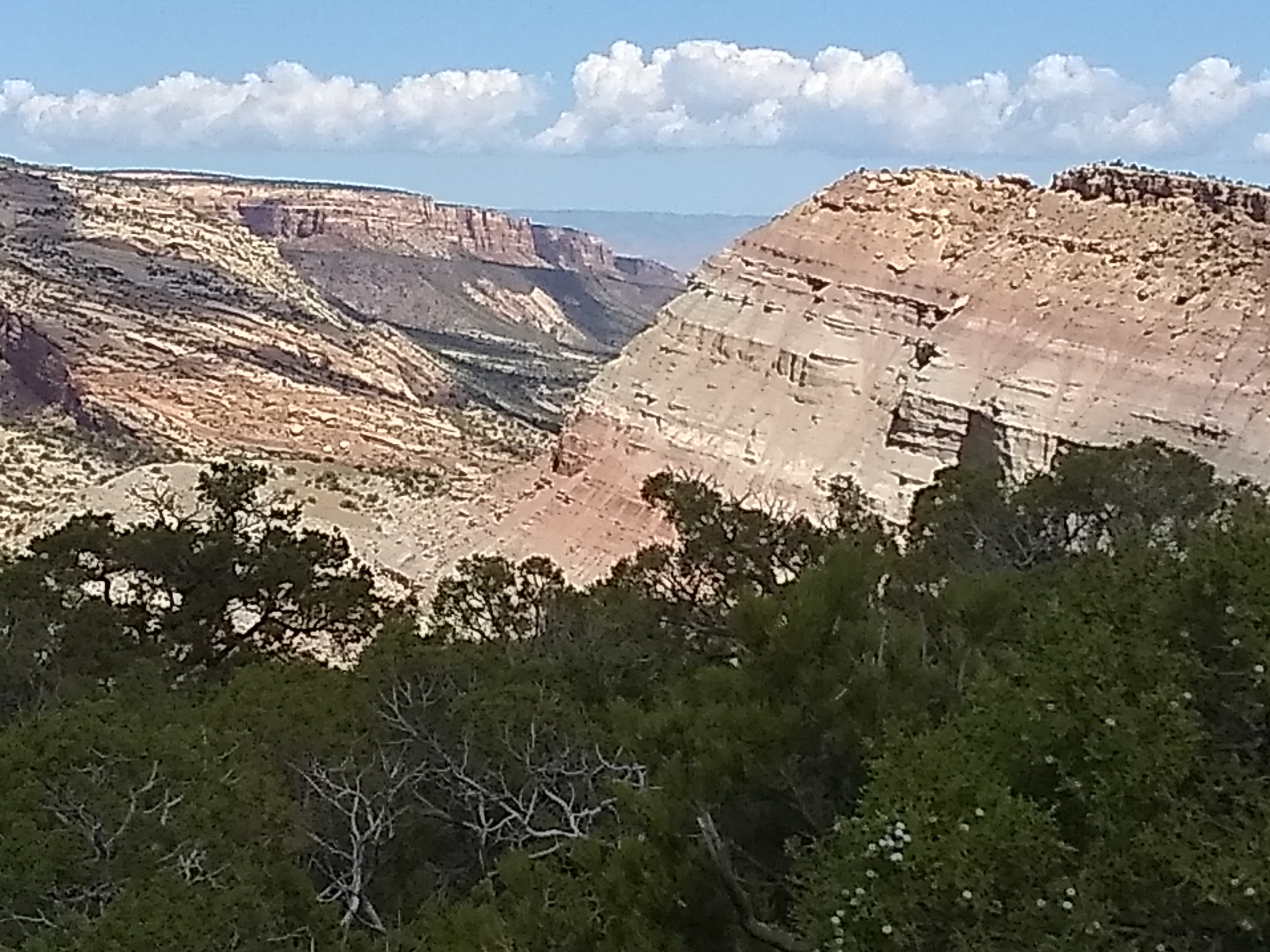
The west slope of the Rockies, the canyons along the Gunnison and Colorado Rivers, the roads through the Colorado National Monument; every view is a spectacle. At one point while looking across the valley at the plateau topped mountains, Syarra declared those were not mountains but a painting. They are that majestic and artistic.

In the distance, does that not look painted?
 My brother, Adam, came to Grand Junction to visit. We went out in his truck and drove into public lands with petroglyphs and narrow canyons. You can see the stripes of each separate sedimentary layer in the different kinds of sandstone. Sometimes the canyon walls look like bubbles burst out of them. Sometimes you see fallen rocks and you can make out the gaps in the cliffs where that boulder fell from who knows how many millennia ago. Tectonic activity and erosion shaped this land, continue to shape it in patterns that would take lifetimes to observe.

Proof of Adam
And it is out there, public, we are all welcome to visit. You don't have to go to a national park to see some of the wonders. There is magnificence within striking distance and often you are the only ones there. The American West is beautiful.

Spectacle and Splendor

 In the midst of all that, I think I finally won at splendor.

Saturday, August 5, 2023

Vestigial, Colorado - Erich

You know how humans each have an appendix and we don’t know what it does? Or how we have a tailbone which is a fusion of four vertebrae even though we don’t have tails. Or how whales have hip bones which are disconnected from the rest of the skeletal system.

These are all vestigial. This means that they hang around but with a different use (or possibly no use) than what they were originally intended to be. Our appendix must be leftover from an evolutionary ancestor who needed it for some reason. Our tailbones are from our ancestors who had tails to help balance their weight when walking or leaping on all four legs. Whales are marine mammals which evolved from land mammals. Early whales had legs, but that was not of an evolutionary advantage, so now they don’t. But the bones are still there, just in a different form.

We are currently in Grand Junction, Colorado. I wondered, why is the city called Grand Junction? Like tailbones and whale bones, it’s vestigial!

The “junction” in Grand Junction has to do with the confluence of two rivers. It is here that the Gunnison River and the Colorado River meet. But why “Grand”? That’s what is vestigial and what is so interesting.

Prior to 1921, the part of the Colorado River which began in present-day Rocky Mountain National Park and flowed to present-day Canyonlands National Park wasn’t called the Colorado River. It was the Grand River. The Grand River flowed from Colorado into Utah and met the Green River in Canyonlands in Utah. Downstream of that confluence, it was called the Colorado River.

So at the time that Grand Junction was named, this was the location of the confluence of the Gunnison River and the Grand River, flowing downstream as the Grand River. So, it was the Grand Junction, since it was a junction with the Grand River. Isn’t that grand?

What it means is that originally the Colorado River didn’t even flow through Colorado. That brings up a few questions: First question – Why was Colorado named Colorado? As is often the case in the western U.S. there were territories that became states. So the state of Colorado was named for the Colorado Territory. And the Colorado Territory was named because it means “colored red.” A lot of the rock in Colorado (particularly in the west, where I am now) is red.

The Colorado River was named for the same reason. It cuts through much red rock. So neither the river nor the state was technically named for one another.

Second question – How did the Grand River get renamed the Colorado River? That was due to the lobbying of a Colorado Congressman named Edward Taylor. He was a true believer in the wonders of Colorado.

The Colorado River was one of the most important rivers in the western United States. Taylor wanted that famous and important river to be part of his state too. He pushed Congress hard for a resolution to rename the Grand River, to make it more of the Colorado River. And in 1921, they agreed to do so. They passed a joint resolution renaming the Grand River as the Colorado River.

But places like Grand County, Grand Lake, Grand Valley, and yes, Grand Junction, kept their names. I guess that relegated the names of these places to the appendices of Western U.S. History. Which is perfect since they are all vestigial, like our own appendices.

Wednesday, August 2, 2023

I Didn't Say Banana - Erich

The title of this post is a reference to the universally-funny-to-all-seven-year-olds knock knock joke that ends when the joke teller finally says “orange.” My nephew recently told me this joke, and I was eager to get to the orange.

That is what I’m doing now. Alrica, Syarra, and I are crossing the country to reach Syracuse University where Syarra will be a student in the fall. If you don’t already know, Syracuse students are oranges. Yes, their mascot, Otto, is an orange. With legs.

At least an orange is a count noun. Harvard is the crimson? What do you call just one Harvard student? A crimson? Well, only if the student is male. I suspect a female student is a crimdaughter.

My son, while at University of Nevada Reno was a wolf pack. How does that work? That’s already plural. Besides, there are no wolves in Northern Nevada. Of course, there are no oranges grown in Syracuse, New York. But there must be some oranges in the region’s grocery stores.

Now, Carver has shed his wolf pack’s clothing to become a duck. We saw ducks in the Willamette River while we were visiting Eugene. So they do definitely have ducks there. We also saw turkeys (not in the river) but I guess the founders of the school didn’t want their fighting cheer to be “gobble gobble gobble.”

Back to the present trip. We emptied the house and left Reno on Sunday afternoon. We made it as far as Elko, Nevada that day. Along the way we experienced the Mormon crickets that had until recently infested Elko. Mormon cricket is a complete misnomer. They’re not Mormons! In a recent survey, 97% of those questions expressed no religious affiliation. Of the 3% who consider themselves spiritual, most aligned themselves with the worship of Quetzalcoatl. Go figure. Oh, also, they aren’t crickets. They’re katydids and they’re huge! For katydids. Not like bigger than humans. Or even human shoes.

Mormon cricket and shoe
For size comparison


From Elko we traveled to Lehi, Utah. That’s just a bit south of Salt Lake City. And we took a much needed chill day after the frantic work of clearing and cleaning the Reno house. We enjoyed pool of two forms, the swimming kind and the hit balls with sticks kind.

The mountains around the Salt Lake City area are beautiful. This is also true of Reno, but the beauties are different. Certainly the mountains in Utah were more green. That was surprising and maybe isn’t always the case, but is only a function of a very snowy winter this past year. I only get the one snapshot that I get. Though as I write this, rain is falling. So maybe it is more than just one winter.

Our next stop is Grand Junction, Colorado. I can’t want to find out what is joining so grandly.

That’s pretty much all I wanted to say in this post. Though if I had the humor of a seven-year-old, I would restart at the beginning and post the whole thing again. Lucky for you, I am slightly more mature than that – emphasis on the slightly – I will just leave you with this: Orange you glad I didn’t say banana?

Reno Recap - Erich


So, yes, I acknowledge that there was a six-year hiatus in the blog. And it is very fair to say, why? What happened in that period? So, in that same spirit of fairness, let me give you a quick overview of six years in one blog post. (How is that for compression?)

While we were still traveling around the world, we started to talk about to where we might want to come back when we returned to the U.S. We each took a map of the continental U.S. with the state borders drawn in. And everyone then colored their map. You could color an entire state one color or break a state up into different parts and color each part a different color.

Green meant “Yeah, seems like a cool place to live.” Yellow meant “Not exactly eager, but this place would be fine.” Red meant “Uh, no.” Then I compiled a map with the average of everyone’s individual maps. The greener a region, the more everyone valued it as a great place to be. The redder, the more everyone valued it as a great place to avoid. And the state of Nevada: entirely red.

Note that none of us had ever been to Nevada before. SIDEBAR – that’s a bit untrue. When I was seven, my family went, by plane, to California and then back to Iowa (where we lived.) One of those two ways, we had a layover in Las Vegas Airport. I remember this because there were slot machines only a couple feet away from the waiting area by the gates. And my mother was going to teach my brother and me a lesson about gambling. She pulled out a few quarters (they still took quarters in that time) and started plunking them in and pulling the titular one arm of the bandit. On the third or fourth pull, she won. Several more quarters came pouring out of the bandit’s mouth. But to prove her point, she then proceeded to feed in all those quarters until they were no more. The lesson, I suppose, was gambling is a losing game. But I thought maybe there was an alternative lesson. Once the quarters come out, stop! You got lucky, say hooray, and move on. Having said this, or written this, I am not a gambler myself, so maybe I did learn the intended lesson. (Or I learned enough about probability theory in my training as a mathematician to recognize a negative expected value. Didn’t that sound mathy?)

BACK TO THE MAINBAR – None of us had seen Nevada, but we all assumed it was a big desert with little but sand, wind, and casinos. (And airports with casinos in them.) So if it rated so poorly, why did you go there? (I’m speaking as the reader now, or I would have written “why did we go there”.)

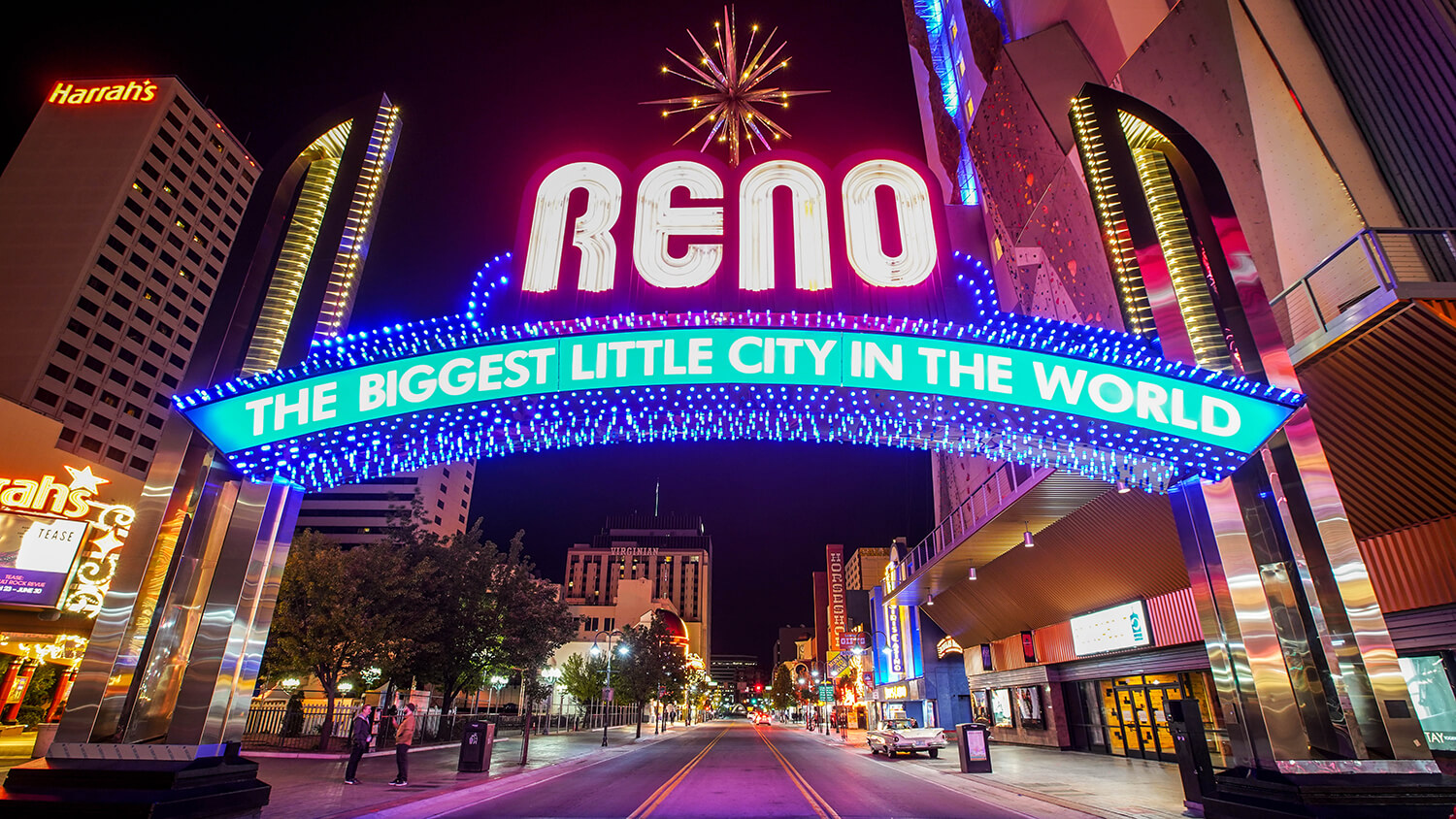
Carver was accepted into a program for profoundly gifted children called the Davidson Institute. They promised that he would be able to continue academically at his own pace, and when he was beyond their curriculum, they would let him enroll in classes at the University of Nevada, Reno (UNR). That’s what led us to living in Reno.

The irony is that we moved there for Carver, and he had the worst experience that first year. The Davidson Institute did not let him move at his own pace. They slowed him down. And then when he finished Multivariable Calculus, they said they would not let him take further math classes at UNR. Given that we had moved there for this program, that was pretty crummy (to say it in nice terms.)

However, the rest of us did well in Reno. It is not a desert, but a rather beautiful city in a valley within the Sierra Nevada mountains. We took Carver out of the Davidson Institute and put in him the Washoe County School District. He went to the Gifted and Talented Institute at Hug High School and things improved dramatically. Plus, they gave us no trouble about taking UNR classes.

Now allow me to present a recap of six years, person by person:

Syarra had a great experience in middle school and then went to the Gifted and Talented Institute at Hug High School. She took a lot of advanced classes including several at Truckee Meadows Community College. In fact, she took enough credits that in her senior year, she only needed one more English class to graduate with the Honors Diploma. I will get to her senior year in a moment. But also on the academic side, Syarra participated in Science Bowl and Academic Olympics. In fact, her Academic Olympics team won first place in Northern Nevada. Syarra was part of an engineering team that built a pumpkin chucker (catapult) and a robot for competitions. She was part of a team that won the National History Day competition at the regional level and she got to travel to Washington, D.C. to represent Nevada in the national competition. The team’s historical presentation was on Disney’s Oswald the Lucky Rabbit.

A pumpkin display created by Syarra and Erich
Not the pumpkins chucked by the chucker


Syarra was very active in Girl Scouts, becoming a student board member for the district and representing the district as a delegate at the national convention. She interned at the Northern Nevada International Center. She earned her biliteracy degree in Spanish.

Back to that senior year, Syarra studied abroad through the U.S. State Department’s Kennedy-Lugar Youth Exchange Study program (YES). Syarra lived in Sarajevo, Bosnia and Herzegovina for ten months where she learned Bosnian, attended an International Baccalaureate school, joined Toastmasters, and competed in Model UN, winning best delegate at one of the competitions and being the runner-up for best delegate at two others. She returned to Reno just in time for graduation at the top of her Hug High class. And now she is on her way to Syracuse University.

Carver, as I mentioned, did spend one school year at the Davidson Institute, but then moved on to better things. He decided he wanted to finish high school and college early. He was allowed to take many classes at UNR while still in high school and graduated in two years. (He did graduate in 2020, which meant his graduation was virtual.) He then continued at UNR. Thanks to all the credits he had already earned, he finished in three years with two majors (physics and applied mathematics) and one minor (linguistics.)

Carver also did Academic Olympics and his team also won first place in Northern Nevada. (This was in a different year than when Syarra’s team won.) Carver founded the science bowl team at Hug High School. And at UNR, he won a computer programming competition. While at UNR, Carver also had a successful trivia team, an active D&D group, and was a member of the Society of Physics Students. In his last year, he became the Secretary for that organization.

As a college graduate, Carver can assure you
that mustard packets are not spoons.


Alrica took a position as the Director of Editorial and Production for the University of Nevada Press. There she fostered many books through the process of publication, and even had a couple get a starred reviews in Publishers Weekly. (To any non-publishers who happen to read this blog, that’s a biggie.)

In December 2019, Alrica left that position to found her own publishing company: Keystone Canyon Press (https://keystonecanyon.com/) Had she known the pandemic would begin three months later, she wouldn’t have started the business at that time. It was rough for a young publishing company, and then with the supply chain issues, there was much frustration. Still, in spite of this, Keystone Canyon published some amazing books. There was a series called Fields of Silver and Gold which covered history of the western United States for children at a middle school level. There was a series of detective novels, the Ratio Holmes series, for upper elementary school kids. (The author – Horatio Holmes – that’s a pseudonym for another author, one whose writing you are reading right now.) There was a very successful picture book for the newest readers that was about the importance of dark skies and nighttime for animals. There were books for adults too. Alrica really wanted to publish books about things that mattered, things that have a positive impact on the world.

Alrica was also active in Girl Scouts, leading the troop, but also engaged with the Service Unit. There she helped plan and run events. (She also spent a lot of hours at cookie booths in inhospitable temperatures. As did Syarra. Don’t worry, both survived.)

You see snakes here, sometimes.


Erich (now going to write in third person) works for Johns Hopkins University. He teaches in their online mathematics department and also for their Center for Talented Youth. He teaches higher level mathematics courses for advanced students. During the pandemic, he also started teaching some courses for UNR. It was virtual the first year and in person after that.

Outside of work, Erich got very active with the theater community in Reno, especially with the Reno Little Theater. He introduced the 24 Hour Plays to Reno, produced a virtual show during the pandemic, and produced some live theater when live theater was allowed. In addition, he acted in, assistant directed for, and stage-managed various productions in Reno. Plus he wrote two long plays: Two Wrongs and FU Aristotle. He made a lot of friends in that community. The hardest part of leaving Reno is leaving them.

24 Hour Plays - get moving!


Along with one of those theatrical friends, Erich started a podcast called Namely (https://namelypodcast.podbean.com/). Each episode explores the history of a name or a group of related names, but with a cartoonish and comical take. Chicken Pox, Dr Pepper, Days of the Week, and others in all kinds of topics.

Obviously, there are many details being glossed over or even left out. But consider this the executive summary or the nearly executed summary.

(Back to first person.) Leaving Nevada, I believe that were we all to color the blank U.S. map again, the Reno area would be a field of green. (Let me have my illusions.)

Monday, July 31, 2023

Thus Untethered - Erich

Driving through southern Oregon, we cross over a waterway. The sign labels it as Lost River, and Alrica immediately states, “I found it!” This makes me wonder: what proportion of people crossing over that bridge make the same comment (or one so closely related as to be indistinguishable as far as the humor goes.) Probably pretty high.

Now you've found the Lost River too!


On the topic of proportions, if I were to ask people if goodbye is a beginning or an ending, which would win? My guess: an ending. “Hello” is the start of a conversation, “goodbye” is the termination. That makes sense. If I started with goodbye I’d be considered rude. And I wouldn’t get to enjoy much social interaction. (I know, reading this you most likely suspect I don’t enjoy much social interaction regardless of how my dialogues commence.)

But if we adjust the context, no longer about a conversation, but instead about an adventure, then goodbye can be the starting point. And so it is. Or will be? Or both?

Our new adventure begins with two goodbyes, to be followed rather soon by a third. It doesn’t start with three goodbyes. That’s because the third of these will happen mid-adventure, though certainly on the early side of the mid.

However, this is all unnecessarily vague. To be plain, we are leaving our home city of six years and taking to the road. Since 2017, we’ve lived in Reno, Nevada. Here our children finished schools of varied levels.

Carver finished high school and his undergraduate work. Syarra completed middle school and high school. So we have no further tethers to Reno or any other city. Thus untethered, we roam.

Carver is now entrenched in Eugene, Oregon. He will be pursuing his doctorate in physics at the University of Oregon.

That brings us to our first goodbye. We said goodbye to Carver, no longer a child. He gets to become an adult, design his own life, shape himself into the independent human he wants to be.

It’s great. Independent fully-functioning adults - the goal of the parent, right? Yet, there is a little hole in my contentedness at present, a nodule of sadness knowing it will be many months until I see him again. In time that void will morph into a kernel of happy memories of my times with my son. But right now – little bit sad.

Then, in three days, we say goodbye (our second goodbye) to Reno. Alrica and I have sold, donated, or disposed of almost everything we own. The little we have left will be crammed into the trunk of our one remaining car – the car which shall not be named – and we are off to the east.

In the three weeks that follow, we will explore new places, visit family in places we’ve been, and trend toward Syracuse, New York. Syarra is starting this fall at Syracuse University. That will be the third goodbye I was teasing earlier in this post.

After our youngest is deposited at her school, Alrica and I become digital nomads. We will be going to housesits, caring for animals, and discovering the wonders of North America. We’d love to see our friends as we pass near them. And, as you may have gathered from this post, we are restarting our blog.

This is a huge empty-nester adventure and it’s wonderful. Except for the saying goodbye (three goodbyes) which kicks it off.

That’s why I feel a bit like the river my wife so cleverly located as we passed over it. Sure, I know where I am. But, like the river, you could legitimately label me as a little bit lost.